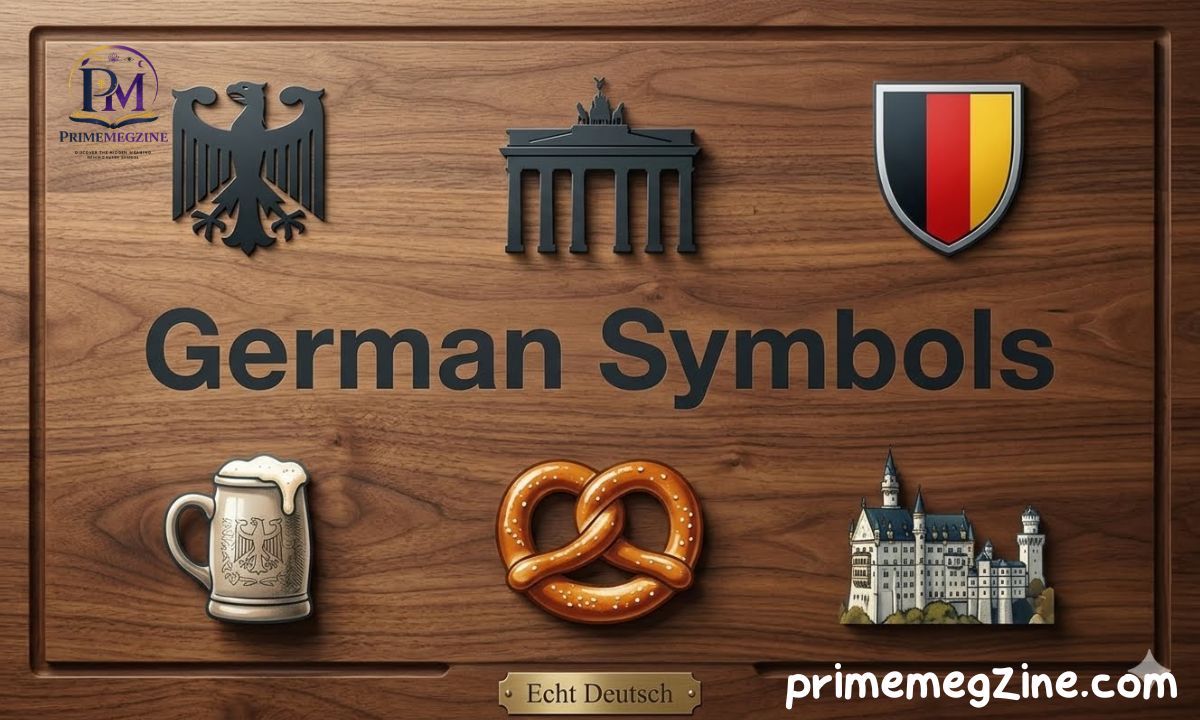
Germany’s history is written in its symbols. From a black eagle that has watched over the nation through empires and reunification, to ancient runes still etched onto jewelry and skin, German symbolism carries layers of meaning most people never stop to unpack.
This guide walks through more than 79 German symbols, covering their history, cultural weight, and the meanings they carry in 2026 — including symbols tied to difficult chapters of the past, explained with the context they deserve.
What are German Symbols?
German symbols are the visual marks, emblems, and motifs tied to Germany’s national identity, regional heritage, and cultural history — including the Federal Eagle, the black-red-gold flag, Holy Roman Empire heraldry, and folk symbols from Germanic tribal life.
Germany wasn’t always one country. Before unification in 1871, the region was a patchwork of kingdoms and free cities, each with its own coat of arms — which is exactly why German symbolism runs so deep, with every era adding a new layer rather than erasing the last one.
Modern German symbols sit at the intersection of that long history and a deliberately rebuilt postwar democracy, which is why a symbol like the eagle can be redesigned again and again while keeping a thread of continuity.
Ancient German Symbols And Their Hidden Stories
Ancient German Symbols
Long before Germany existed as a nation, Germanic peoples carved symbols into weapons, jewelry, and stone for protection and identity. The most well-documented system was runic writing — angular characters scratched into hard surfaces with simple tools.
Germanic Tribe Symbols
Germanic tribes used distinct marks to identify clans, gods, and warriors. Runes on weapons and jewelry suggest that writing itself became a marker of status and identity among early Germanic peoples, signaling who someone was and where they belonged.
Germanic Symbols
The oldest and best-attested Germanic symbol system is the Elder Futhark, a runic alphabet of 24 characters used by ancient Germanic and Nordic tribes, with each rune carrying its own meaning tied to guidance, protection, and transformation. The earliest confirmed runic inscription dates to around 160 CE, found on a comb in Denmark, carved confidently enough that scholars believe the tradition was already a century old by then.
German Symbols And Meanings In Modern Culture
German Symbols And Meanings
In modern Germany, symbols fall into two buckets: state symbols that represent the country officially, and cultural symbols that carry folklore or regional pride. The eagle anchors the first category; oak leaves, runes, and regional crests anchor the second.
German Symbolism
German symbolism blends mythology, statecraft, and design philosophy. A single symbol like the eagle can reference imperial Rome, medieval heraldry, and 21st-century democratic government all at once — part of why German visual identity feels so layered.
Symbols Of Germany
The core symbols of Germany today are the Federal Eagle (Bundesadler), the black-red-gold flag, and cultural icons like the oak tree and the Brandenburg Gate. These appear on currency, passports, and government buildings.
What Is The Symbol Of Germany?
The official symbol of Germany is the Bundesadler, a black eagle with outstretched wings on a gold shield. The same design has remained in use by the Federal Republic of Germany since 1950 under the name Bundesadler, or “Federal Eagle.” It traces back to the Reichsadler of the Holy Roman Empire and represents sovereignty rather than any single ruler.
German Symbols Text, Letters, and Tattoos
German Symbols Text
People search for German symbol text mainly to find runic characters for usernames or art projects. Most of what circulates online as “German text symbols” is actually Elder Futhark or Younger Futhark script, repurposed for visual use rather than communication.
German Symbols Letters
The closest thing to “German symbol letters” historically is the runic alphabet itself, alongside blackletter typefaces like Fraktur, used in German printing for centuries before falling out of everyday use after World War II.
German Symbols To Copy
Commonly copied symbols include individual Elder Futhark runes, the Iron Cross outline, and stylized eagle silhouettes. A few runic symbols carry sensitive associations due to their use by extremist groups in the 20th century, so context matters when choosing one.
German Symbols Tattoos
Tattoo seekers are usually drawn to runes and the Iron Cross shape for their visual boldness and connection to strength and heritage. Because some of these symbols carry a complicated 20th-century history, many people research the specific mark carefully before getting it permanently inked.
Iconic, Ancient And Historical German Symbols
Iconic German Symbols
The Federal Eagle and the Iron Cross are the two most internationally recognized German symbols. The Iron Cross has grown to represent the entire German military, with the modern Bundeswehr adopting it as its identifying emblem.
Traditional German Symbols
Traditional symbols outside state heraldry include the oak tree, tied to strength and endurance in Germanic folklore, along with regional crests from former kingdoms like Bavaria and Saxony.
Famous German Symbols
Castles, coats of arms, and the Brandenburg Gate round out the list of globally famous German symbols, reflecting centuries of architectural and political history rather than any single era.
Ancient German Symbols Tattoos
Norse and Germanic-inspired tattoos typically draw from the same Elder Futhark rune set, with individual runes like Algiz (protection) or Tiwaz (courage) chosen for personal rather than national meaning.
Old German Symbols
Before unification, “German” symbols were really regional symbols — separate coats of arms for places like Prussia, Bavaria, and Saxony, each reflecting local ruling houses rather than a unified identity.
Meaningful German Symbols
Symbols that carry the deepest personal meaning in German culture tend to be tied to family and land — the oak, the family crest, regional emblems — rather than national political symbols.
German Symbols In War, Politics and Family
WW1 German Symbols
The Iron Cross was the defining German military symbol of the First World War. First introduced in 1813 by King Frederick William III of Prussia, the medal was revolutionary for its time, awarded on merit rather than noble birth, and it was revived for WWI use as a widely worn mark of valor.
WW2 German Symbols
This is one of the most historically sensitive areas of German symbolism. In 1939, the Iron Cross was reinstated as the official decoration of the Third Reich with a swastika added at its center, tying it directly to the Nazi regime. The Nazi Eagle, developed by the Nazi Party in the 1920s, is now treated as a distinct and widely condemned symbol of that era — neither variant is used by modern Germany, and both are legally restricted there today.
WWII German Symbols
Beyond the swastika-era Iron Cross and eagle, WWII-era symbols included unit insignias, the Balkenkreuz (bar cross) used on vehicles, and party flags — all now regulated under German law due to their Nazi associations.
East German Symbols
East Germany (the GDR) used a distinct emblem from 1955 until reunification in 1990: a hammer and compass surrounded by wheat, with the hammer representing factory workers, the compass the intelligentsia, and the wheat the farmers. It was added to the flag in 1959 to distinguish the GDR from West Germany, since both states had shared the same tricolor for their first decade.
German Symbols For Family
Family-oriented German symbols lean on heraldry — a family crest, oak leaves, or a regional coat of arms — used to mark heritage, generational continuity, and a connection to a specific homeland or town.
Popular German Symbols
The most widely recognized popular symbols today blend statehood and culture: the Federal Eagle, the black-red-gold flag, the Brandenburg Gate, Bavarian folk imagery, and the beer stein as an informal cultural icon.
Deep Symbolic Meaning of German Symbols
German symbols carry meaning on more than one level — spiritual, psychological, and cultural — often simultaneously.
Spiritual Meaning
In early Germanic tribal life, symbols like runes were believed to hold protective and prophetic power — Vikings and related peoples believed runic symbols could foretell the future and protect those who carried them. That spiritual layer still shapes how runes are used in modern pagan and New Age practice.
Psychological Meaning
Psychologically, symbols like the eagle tap into a basic human draw toward authority and strength. Repetitive geometric patterns, like those in runic script, appeal to the mind’s preference for structure and order — part of why these symbols still feel powerful stripped of their original context.
Cultural Meaning
Culturally, German symbols reflect a national story of rebuilding. Germany has redefined its symbols multiple times — imperial eagle, Weimar tricolor, Nazi-era marks, divided East/West emblems, and a reunified democratic identity — making its symbolism a visible record of historical change.
Types / Variations of German Symbols
| Symbol | Visual Description | Meaning | Where It Appears |
| 1. Federal Eagle (Bundesadler) | Black eagle, wings spread, on a gold shield | Sovereignty and national unity | Government buildings, passports, official seals |
| 2. Black-Red-Gold Flag | Three horizontal stripes: black, red, gold | Freedom, unity, democracy | National events, sports, official ceremonies |
| 3. Iron Cross (Eisernes Kreuz) | Black cross pattée with white or silver trim | Military valor and honor (historical); modern Bundeswehr emblem | Military history, Bundeswehr insignia, vehicles |
| 4. Germanic Runes (Elder Futhark) | Angular carved characters | Protection, communication, ritual meaning in ancient belief | Archaeological artifacts, modern neopagan and spiritual practice |
| 5. Holy Roman Empire Eagle (Reichsadler) | Double-headed eagle | Dual spiritual and political authority | Medieval banners, imperial seals, historic coats of arms |
German Symbols Across Cultures
Ancient Germanic Tribes
Early Germanic symbolism was tied closely to spiritual life, with marks carved into wood, weapons, and stone meant to offer protection and signal identity within a tribe.
Roman Influence
The eagle motif traces back to Roman military standards, the Aquila, which referred to sovereign command rather than any individual ruler. As Germanic regions came into contact with Rome, that imperial eagle tradition was absorbed into emerging Germanic heraldry.
Medieval Europe
By the medieval period, coats of arms had become essential identifiers for noble families and knights. An early depiction of a double-headed Imperial Eagle in a heraldic shield, attributed to Frederick II of Hohenstaufen, appears in the Chronica Majora around 1250.
Modern Europe
After 1945, German symbolism shifted deliberately toward restraint, democracy, and unity, distancing itself from imperial and wartime imagery while preserving symbols, like the eagle, that could be redesigned for a peaceful state.
Global Influence
Beyond literal symbols, German design philosophy — precision, minimalism, function over ornament — has shaped global branding and architecture well outside Germany’s borders.
German Symbols in Art, Movies & Pop Culture
German symbols show up constantly in global media, almost always carrying historical or emotional weight rather than appearing as neutral decoration.
- Historical war films use Iron Cross and eagle imagery to signal a specific era and its politics.
- Medieval and Renaissance paintings often depict heraldic eagles and shields as markers of noble lineage.
- Runes appear widely in fantasy fiction and video games as stand-ins for ancient magic or hidden knowledge.
- In fashion and streetwear, the Iron Cross shape has been adopted by biker and rock subcultures since the 1960s, often stripped of its original military meaning.
Spiritual & Dream Meaning of German Symbols
When German-associated symbols appear in dreams or meditation, interpretation tends to be symbolic rather than literal.
- Eagle: Leadership, clarity, and rising above a difficult situation.
- Runes: Hidden knowledge, intuition, or guidance surfacing from the subconscious.
- Cross shapes: Inner conflict, moral decision-making, or a turning point.
- National emblems: A search for identity or a pull toward heritage and roots.
Positive vs Negative Meaning
| Aspect | Positive Meaning | Negative Interpretation |
| Eagle / Bundesadler | Unity, sovereignty, democratic strength | Historically linked to imperial overreach |
| Iron Cross | Valor, military honor, resilience | Adopted by neo-Nazi and white supremacist groups as a hate symbol when combined with a swastika |
| Runes | Protection, ancestral wisdom, spiritual guidance | Co-opted into Nazi-era mysticism, particularly through Karl Maria Wiligut’s “Wiligut runes” used in SS insignia, and still used by some neo-Nazi groups today |
| Black-red-gold flag | Freedom, unity, peaceful democracy | Rarely contested; broadly seen as a positive postwar symbol |
The lesson across all of these is consistent: meaning depends on era, context, and intent, not on the shape of the symbol alone.
Why Humans Are Attracted to German Symbols
People are drawn to German symbols because they combine clean visual structure with centuries of layered story. The brain naturally favors pattern and symmetry, and Germanic design — angular runes, balanced heraldry, a single bold eagle — delivers both.
There’s also an emotional pull tied to resilience. German symbols have been rebuilt and reclaimed multiple times across history, and that pattern resonates with a universal human experience, regardless of nationality.
FAQs about German Symbols
What is the most important German symbol today?
The Bundesadler, or Federal Eagle, is the most recognized official symbol of modern Germany, appearing on government buildings and documents.
What do German runes mean?
Runes are ancient Germanic characters tied to writing, ritual, and, in early belief systems, protection and fate.
Why is the eagle used in German symbolism?
The eagle traces back to Roman imperial symbolism and represents sovereignty, strength, and continuity of authority.
Are German symbols religious?
Some ancient symbols, like runes, had spiritual origins, but most modern German national symbols are political or cultural rather than religious.
What does the German flag represent?
The black-red-gold tricolor represents freedom, unity, and democracy, dating back to the Weimar Republic and earlier 19th-century liberal movements.
Are all German symbols ancient?
No. Many, including the current Bundesadler design, were deliberately created or redesigned after 1949 to reflect a unified democratic Germany.
Why are German symbols so powerful in design?
They combine centuries of historical weight with clean, structured visual forms, making them instantly recognizable and emotionally resonant.
Conclusion
German symbols are not static decorations — they’re a visual record of a country that has been rebuilt, redivided, and reunified more than once. From ancient runes carved for protection to the modern Bundesadler representing a democratic state, each symbol carries the fingerprints of the era that shaped it.
Looking past the surface of these symbols means understanding a much bigger story: one of transformation, caution, and the ongoing effort to separate cultural heritage from its darkest historical misuses.

Steve Carell writes simple Symbol Meanings articles on primemegzine.com, helping readers easily understand signs, symbols, and hidden meanings.