The Cherokee people have carried their symbols through centuries of storytelling, ceremony, and survival. Long before social media turned ancient signs into tattoo trends, these symbols guided real decisions about family, protection, and spiritual balance. They still do.
This guide walks through the most meaningful Cherokee symbols — where they come from, what they actually represent in Cherokee culture, and why so many people are drawn to them today. Wherever a meaning is tied to official Cherokee Nation sources, that’s noted clearly, since not every popular “Cherokee symbol” claim online holds up to scrutiny.
What are Cherokee Symbols?
Cherokee symbols are visual marks, signs, and figures used by the Cherokee — one of the largest Indigenous nations in North America — to represent ideas, beliefs, and values. Some come from a documented writing system. Others come from oral tradition, ceremony, and art passed down through generations.
The most concrete example is the Cherokee syllabary, created by Sequoyah in the early 1800s. It uses 85 characters, each representing a syllable sound rather than a single letter, which made it possible for Cherokee speakers to read and write their own language quickly.
Beyond the syllabary, Cherokee symbolism shows up in:
- Pottery and basket-weaving patterns
- Beadwork and clothing design
- Ceremonial objects and stomp dance regalia
- Oral stories passed between generations
- Official seals and flags
Each of these carries a thread of meaning connecting people to nature, ancestry, and identity.
Cherokee Symbols And Tribal Meanings
Cherokee Flag
The Cherokee Nation flag centers on the official seal: a seven-pointed star wrapped in a wreath of oak leaves, set against an orange background. Around the star sit seven smaller stars representing the seven traditional Cherokee clans, plus one black star added to honor those who died during the Trail of Tears. A rope border runs around the flag’s edge, symbolizing strength and endurance.
The seal itself dates back to an 1869 act under Chief Lewis Downing, and the wording around it records September 6, 1839 — the date the Cherokee Nation’s first constitution was signed after removal to Indian Territory.
Cherokee Symbols And Meanings
Most authentic Cherokee symbolism falls into a few recurring categories: numbers (especially four and seven), natural elements (water, fire, the four directions), and animals tied to specific traits. None of these symbols stand alone — they’re almost always explained through a story, a ceremony, or a clan connection rather than as decoration.
Cherokee Nation Symbols
The official symbols of the Cherokee Nation are tightly defined: the seven-pointed star, the oak leaf wreath, and the seal itself. These appear on government documents, the flag, and tribal seals, and they specifically represent governance, unity among the clans, and the “eternal flame” of the Cherokee people — not generic spirituality.
Cherokee Symbols Tattoos
Cherokee-inspired tattoos have become genuinely popular, largely because the designs combine clean visual lines with meanings people find personally relevant. The most requested designs tend to draw from animal totems, feathers, and elemental symbols rather than the official tribal seal, which is generally treated as a governmental emblem rather than personal body art.
Cherokee Symbols And Meanings Tattoos
People choosing these tattoos are typically drawn to specific qualities they want represented — protection, family loyalty, courage, or healing. A wolf might be chosen for loyalty, a bear claw for strength, or an eagle feather for honor and connection to the divine.
A respectful approach means understanding the cultural weight behind a design before getting it permanently inked, rather than picking a symbol purely because it looks striking.
Cherokee Symbol For Protection
The bear is the animal most consistently tied to protection in Cherokee tradition. Its claw or paw print is used to represent strength paired with guardianship — the idea of a powerful presence that shields family and community rather than threatens it. Eagle feathers also carry a protective meaning, often linked to spiritual guidance during difficult times.
Family Strength And Warrior Traditions
Cherokee Symbols For Family
Cherokee clan identity has always passed through the mother’s line, which makes family symbolism deeply tied to lineage rather than just sentiment. The wolf is the animal most associated with family in Cherokee tradition — wolves live and hunt in tight-knit packs, and that cooperative loyalty is mapped directly onto human family bonds.
Cherokee Symbol For Warrior
Cherokee warrior symbolism draws on feathers, the eagle, and certain geometric patterns once used in ceremonial dress. Eagle feathers in particular were — and still are — earned, often given to recognize bravery, leadership, or service to the community rather than handed out freely.
Cherokee Symbol For Strength
Strength symbolism centers on the bear, recognized across Cherokee tradition for endurance, resilience, and the ability to recover from hardship. The bear’s paw print remains one of the most widely used strength symbols in both traditional art and modern tattoo design.
Native American Symbols Meanings
It’s worth pausing here on an important distinction: “Native American symbols” is not one unified system. Hundreds of distinct tribal nations exist across North America, each with its own language, ceremonies, and symbolic traditions. A symbol that holds deep meaning for the Cherokee may carry a completely different meaning — or none at all — in Lakota, Navajo, or Haudenosaunee culture.
Treating “Native American symbolism” as interchangeable is one of the most common mistakes in this space, and it tends to flatten distinct, living cultures into a single generic aesthetic.
Indian Cherokee Tattoos
Cherokee tattoo designs frequently combine more than one symbol — a feather layered with a bear claw, or a wolf set inside a circle representing the four directions. These combinations let a single piece of art carry several meanings at once: protection, family, and spiritual balance together.
Cherokee Indian Tribal Tattoos
Traditional Cherokee tribal art historically leaned on hand-tapped or hand-poked techniques, long before modern tattoo machines existed. Designs were tied to personal achievement, social standing, or spiritual milestones — not chosen casually. That history is part of why many cultural voices encourage learning the story behind a design, or even consulting Cherokee artists directly, before adopting one.
Deep Symbolic Meaning
Spiritual Level
On a spiritual level, Cherokee symbols reflect balance — between the physical world and the spiritual one, between the four directions, between the individual and the community. The circle is central here: in ceremony, it represents the unbroken cycle of life, the seasons, and the connection between everything living.
Psychological Level
Psychologically, these symbols speak to something universal: the human need to find identity and grounding in something larger than ourselves. When people connect with a Cherokee symbol — a bear for strength, a feather for guidance — they’re often responding to a quality they want to recognize or build in themselves.
Cultural Level
Culturally, Cherokee symbols are living history. They carry forward language, ceremony, and clan structure that survived forced removal, cultural suppression, and generations of change. Each symbol used today is a continuation of that resilience, not a relic of it.
Types / Variations of Cherokee Symbols
| Symbol | Core Meaning | Common Setting |
| Seven-Pointed Star | The seven Cherokee clans | Flag, seal, official emblems |
| Water Symbol | Purification, renewal, life | Pottery, ceremony |
| Fire Symbol | Transformation, the eternal flame | Ceremonial fires, seal symbolism |
| Medicine Wheel / Four Directions | Balance across body, mind, spirit, and the seasons | Healing practices, teachings |
| Animal Totems | Specific traits (loyalty, strength, vision) | Stories, carvings, tattoos |
| Feather Symbol | Honor, connection to the Creator | Ceremonial regalia, earned recognition |
1. The Seven-Pointed Star
This is the most officially documented Cherokee symbol that exists. It represents the seven traditional Cherokee clans and appears at the center of the Cherokee Nation seal and flag. Some sources also connect it to the seven core characters in Sequoyah’s syllabary that spell “Cherokee Nation.”
2. The Water Symbol
Water appears throughout Cherokee ceremony as a force of purification and renewal. Flowing or wave-like patterns in traditional pottery and art represent the ongoing cycle of cleansing — physically and spiritually.
3. The Fire Symbol
Fire carries dual weight in Cherokee tradition: it creates and it transforms. The “eternal flame” referenced in the Cherokee Nation seal connects directly to the sacred fire historically kept burning within Cherokee communities, traditionally fueled by oak.
4. The Medicine Wheel (Sacred Circle)
Often shown as a circle divided into four sections, this symbol represents the four directions and the balance between physical, mental, emotional, and spiritual health. It’s used in healing traditions as a reminder that no single part of a person’s life exists separately from the rest.
5. Animal Symbols (Totems)
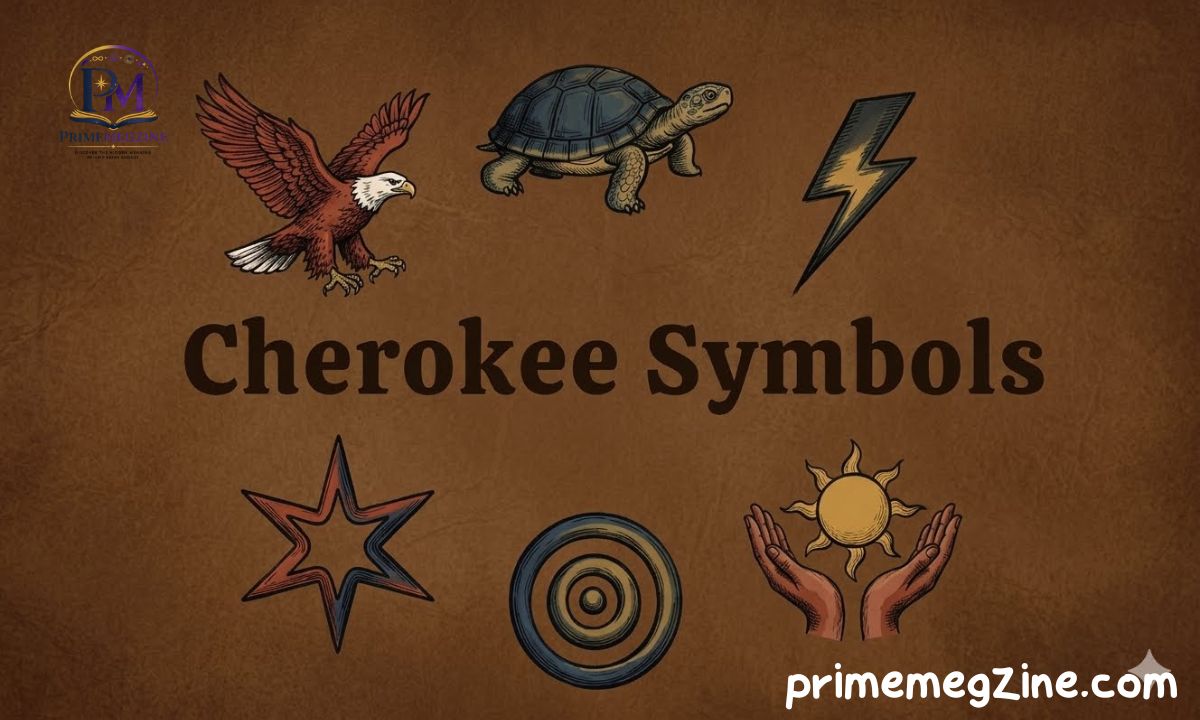
Animal symbolism is where Cherokee meaning gets specific. A few of the most recognized:
- Wolf — loyalty, family, cooperative strength
- Bear — protection, resilience, healing
- Eagle — vision, courage, closeness to the Creator
- Owl — premonition, sometimes a warning of danger ahead
- Turtle — patience, longevity, wisdom
6. Feather Symbol
A single feather — especially an eagle feather — represents honor and a direct line of communication with the Creator. Historically, receiving a feather wasn’t casual; it recognized bravery, leadership, or meaningful service to the community.
Cherokee Symbols Across Cultures
Symbolic thinking isn’t unique to the Cherokee, even if the specific meanings are. Circular symbols of unity and eternity appear in Celtic knotwork. Balance-focused dualities echo in Eastern philosophy’s yin and yang. African tribal art uses pattern and symbol to preserve oral history in a strikingly similar way to Cherokee tradition.
The common thread across all of these isn’t shared symbolism — it’s the shared human instinct to encode meaning visually when words alone aren’t enough.
Cherokee Symbols in Art, Movies & Pop Culture
Cherokee symbolism shows up across:
- Art and jewelry — often used to celebrate heritage and identity
- Tattoos — the most visible modern application
- Literature and film — sometimes used (and sometimes oversimplified) to signal Indigenous identity or connection to nature
- Fashion — Cherokee-inspired patterns occasionally appearing in textile design
The respectful version of this trend involves understanding what a symbol actually means before using it. The disrespectful version flattens sacred meaning into pure decoration.
Spiritual & Dream Meaning of Cherokee Symbols
People who encounter Cherokee-style symbols in dreams or meditation often interpret them along these lines:
- Circle — a search for closure or balance
- Water — emotional healing or renewal taking place
- Animal figures — intuition or instinct trying to guide a decision
- Feather — a sense of spiritual reassurance or presence
These interpretations come from broader symbolic and dream-work traditions rather than documented Cherokee religious teaching, so they’re best understood as personal reflection rather than cultural fact.
Positive vs Negative Meaning
Positive Meanings
- Connection to nature and the four directions
- A felt sense of family loyalty and protection
- Personal resilience and strength
- Unity across community and clan
Negative Meanings
- Symbols stripped of context and turned into pure fashion
- Sacred designs misattributed or invented to fit a trend
- Flattening distinct tribal traditions into one generic “Native” aesthetic
A symbol’s impact depends heavily on whether it’s used with understanding or without it.
Why Humans Are Attracted to Cherokee Symbols
People are drawn to Cherokee symbols for a few consistent reasons:
- They represent values — loyalty, courage, protection — that feel timeless
- They connect to nature in a way modern life often lacks
- They carry a sense of history and survival that feels meaningful to honor
That pull is emotional as much as visual. A bear claw tattoo isn’t really about the bear — it’s about the strength the wearer wants to carry with them.
FAQs
1. What do Cherokee symbols represent?
They represent spiritual beliefs, clan identity, natural elements, and core values like protection, family, and balance within Cherokee culture.
2. Are Cherokee symbols the same as the Cherokee alphabet?
No. The Cherokee syllabary, created by Sequoyah, is a writing system with 85 characters, separate from symbolic art and ceremonial signs.
3. Can anyone use Cherokee symbols?
They can be appreciated, but using sacred or clan-specific symbols without understanding their meaning is widely considered disrespectful by Cherokee cultural voices.
4. What is the most important Cherokee symbol?
The seven-pointed star is the most officially significant, representing the seven Cherokee clans on the tribal seal and flag.
5. Do Cherokee symbols have spiritual power?
Within Cherokee belief, yes — symbols like fire, water, and the medicine wheel are tied directly to ceremony, healing, and spiritual balance.
Conclusion
Cherokee symbols carry more than visual appeal — they carry clan identity, survival, and a worldview built on balance between people and nature. The seven-pointed star, the sacred fire, the bear’s protective strength: each one is a thread connecting the present to a much longer story.Approaching these symbols with curiosity is a good start. Approaching them with respect — and a willingness to learn their real context — is what actually honors the culture behind them.

Steve Carell writes simple Symbol Meanings articles on primemegzine.com, helping readers easily understand signs, symbols, and hidden meanings.