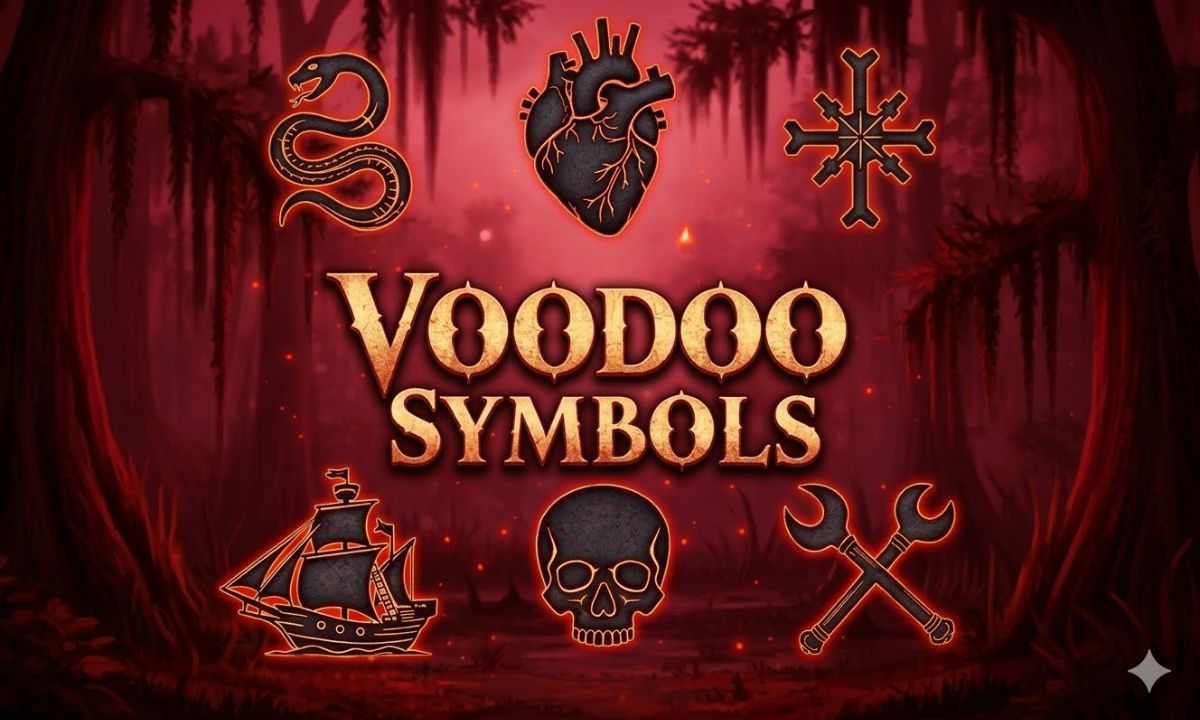
Voodoo symbols have fascinated people for centuries because of their rich history, spiritual meaning, and cultural significance. These symbols, often known as veves, are used in spiritual traditions to represent different spirits, energies, and sacred connections. Each sign carries a unique message and reflects beliefs that have been passed down through generations.
In this guide, you’ll discover 70+ powerful Voodoo symbols and their hidden meanings. From symbols linked to protection and wisdom to those associated with strength, love, and guidance, each one tells a story. Understanding these symbols can help you appreciate the history, traditions, and spiritual heritage behind them in 2026 and beyond.
What Are Voodoo Symbols?
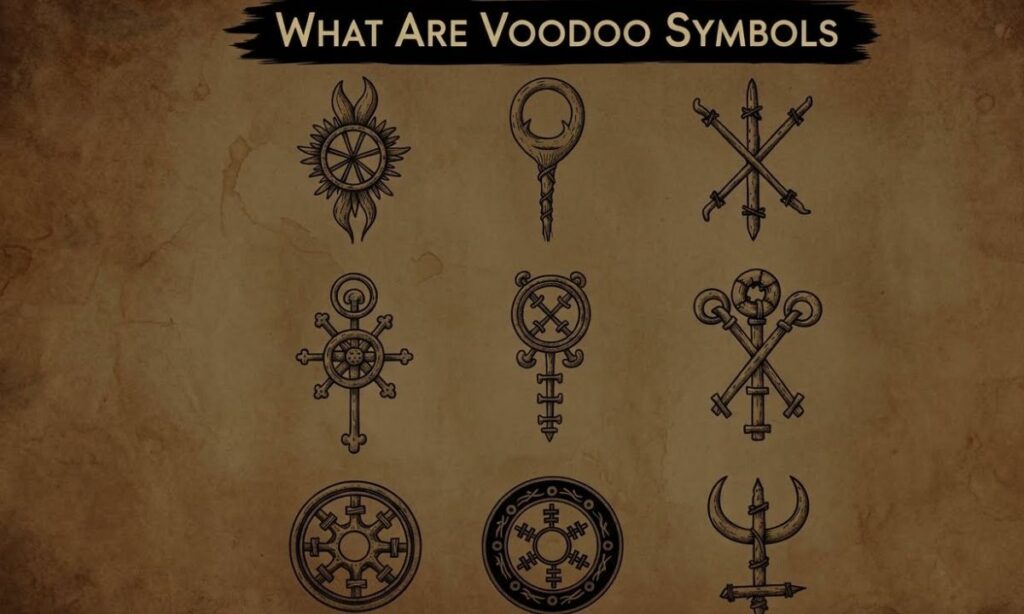
Voodoo symbols, formally known as veves (also spelled vèvè or vevè), are sacred ritual designs used in Haitian Vodou and related African diaspora religions. These intricate geometric drawings serve as spiritual beacons — each one acts as a direct channel between the practitioner and a specific divine spirit called a Lwa (or Loa).
During ceremonies, veves are carefully drawn on the ground using powdered substances such as cornmeal, wheat flour, wood ash, or red brick powder. The choice of material depends on the ritual and the tradition. In Haitian Vodou specifically, a blend of cornmeal and wood ash is most common. Every line, curve, and cross carries intentional meaning — these are not decorative drawings but living spiritual addresses.
The word “voodoo” traces back to the Fon word vodun, meaning spirit or deity. The religion developed primarily in Haiti when enslaved Africans carried their West African spiritual systems across the Atlantic, blending them with Catholic iconography as a strategy of survival under colonial rule. Despite what Hollywood portrays, Vodou is not a tradition of dark curses. It is a complex, community-centered faith rooted in ancestor reverence, healing, and spiritual balance.
Voodoo Symbols | Meanings, Uses and Types
Each veve represents one of the Lwa — the spiritual intermediaries that stand between humanity and the supreme creator, known in Haitian Vodou as Bondye. When a veve is drawn with proper intention and accompanied by offerings, drumming, or chanting, it invites the corresponding Lwa into the ceremony.
Scholars suggest veves may have roots in the Nsibidi writing system of West and Central Africa, or in the cosmograms of the Kongo people. Over centuries, these sacred scripts evolved into the elaborate designs seen in Vodou rituals today.
| Category | Purpose | Common Lwa Invoked |
| Protection | Guard against evil and negative energy | Ogou, Marasa |
| Love | Attract romance and strengthen bonds | Erzulie Freda |
| Death & Transition | Honor ancestors and mark transformation | Baron Samedi, Ghede |
| Creation & Wisdom | Connect to cosmic origins | Damballa, Ayida Wedo |
| Crossroads & Opportunity | Open spiritual doors, guide decisions | Papa Legba |
| Agriculture & Abundance | Invite fertility and earthly blessings | Azaka |
Voodoo Symbols for Death
Symbols associated with death in Vodou carry a meaning far removed from fear or darkness. They represent transformation, the cycle of life, and the honoring of ancestors. The veve of Ghede, spirit of death, features a cross with skull and crossbones imagery — not as a warning, but as an acknowledgment that death is a natural passage, not a punishment. These symbols are used in funerary rites, ancestor ceremonies, and rituals of spiritual transition.
Voodoo Symbols PDF
For those who wish to study veves in depth, downloadable PDFs offer detailed drawings alongside historical context, ritual uses, and Lwa correspondences. These resources are particularly valuable for researchers, spiritual practitioners, and artists seeking accurate representations rather than pop-culture distortions.
Voodoo Symbols for Good Luck
Several veves are specifically invoked to attract positive energy, abundance, and open pathways. Practitioners draw or display these symbols to invite success, remove obstacles, and align daily life with spiritual favor. Azaka’s veve — representing the agricultural Lwa — is often used for abundance and earthly blessings.
Voodoo Symbols Meaning
Understanding voodoo symbols meaning requires knowing which Lwa each design represents. Using a symbol without understanding its spiritual identity is considered disrespectful in traditional practice. Each veve encodes coded imagery that reflects the personality, domain, and ancestral lineage connected to that spirit.
Voodoo Symbols Images
Visual references are essential when learning veves. Authentic voodoo symbols images show the intricate, hand-drawn quality of these designs — featuring layered geometric shapes, symbolic tools (like swords, keys, or hearts), and patterns that reflect the corresponding spirit’s domain. Many veves are also reproduced in banners, paintings, and patchwork by Haitian artisans.
Voodoo Symbols Alastor
In certain esoteric and occult traditions outside mainstream Vodou, Alastor is referenced as a spirit of vengeance or divine retribution. Symbols linked to Alastor tend to appear in Western ceremonial magic contexts rather than traditional Haitian Vodou. These carry associations with justice, karmic consequence, and powerful, deliberate spiritual intention.
Voodoo Symbols for Love
Love veves are among the most widely recognized in Vodou. Erzulie Freda’s symbol — a decorated heart adorned with curls, mirrors, and combs — is the primary emblem of romantic and emotional energy. Practitioners invoke this veve for attracting partners, healing broken relationships, and restoring emotional harmony. Erzulie embodies the full spectrum of love, from joy and beauty to grief and longing.
Voodoo Symbols for Protection
Protection is one of the most common reasons people engage with voodoo symbols today. Protective veves are placed in homes, worn as amulets, or drawn during ceremonies to create a spiritual barrier against negative forces. These symbols do not attack — they shield.
Understanding Voodoo Symbols and Their Meanings
Voodoo Symbols and Meanings
Every veve is a direct representation of its Lwa’s personality, domain, and power. The symbols of voodoo are not interchangeable — each holds specific energy that must be understood before use. In Haitian Vodou, using a veve incorrectly or without knowledge is believed to produce ineffective or confusing results.
Vodou Symbols
The term “vodou symbols” refers specifically to veves within the Haitian Vodou tradition. These spiritual signatures are drawn with precision during ritual. Even the act of drawing is sacred — it must be executed carefully, as the accuracy of the design is believed to influence the power and clarity of the Lwa’s presence.
Symbols of Voodoo
The broader category of symbols of voodoo includes not just veves but also sacred objects, colors, numbers, and ritual tools associated with each Lwa. For example, Baron Samedi’s symbols extend to the top hat, black tailcoat, cigars, and rum that practitioners offer him.
Voodoo Religion Symbols
Voodoo religion symbols are sacred within their ceremonial context. They are not decorations or logos — they are functional spiritual instruments. In community rites, their presence signals which Lwa has been invited and what kind of spiritual energy is being called forward.
Voodoo Religion Symbol
A single voodoo religion symbol can anchor an entire ritual. Papa Legba’s cross, for example, must be drawn first at every ceremony — without it, no other Lwa can enter. One symbol carries the power to open or close spiritual access.
Voodoo Symbolism Religion Symbols
Voodoo symbolism reflects a deeply layered spiritual worldview in which the visible and invisible worlds are constantly in dialogue. The symbols serve as grammar in that conversation — structured, intentional, and alive with meaning shaped by centuries of oral and ritual tradition.
Voodoo Symbols and Their Meanings
| Symbol | Lwa | Core Meaning |
| Crossroads with cane and keys | Papa Legba | Gateway, destiny, spiritual access |
| Decorated heart with curls | Erzulie Freda | Love, beauty, feminine power |
| Cross with skull motifs | Baron Samedi | Death, resurrection, transformation |
| Dual intertwined serpents | Damballa | Creation, purity, cosmic wisdom |
| Sword with geometric lines | Ogou | Strength, war, protection |
| Plow and sheaf of corn | Azaka | Agriculture, abundance, earth |
Voodoo Symbols and Meaning
Context shapes everything in Vodou symbolism. A veve drawn with healing intention carries healing energy. The same design drawn carelessly or without ceremony holds no spiritual weight. This is why practitioners emphasize knowledge, respect, and ritual precision above all.
Types of Voodoo Symbols Around the World
Haitian Voodoo Symbols
Haitian voodoo symbols are the most widely documented and recognized form of veves. They developed during the colonial period as enslaved Africans in Saint-Domingue (now Haiti) preserved their spiritual practices by layering them beneath Catholic imagery. Each Haitian Lwa has at least one, sometimes multiple, distinct veve based on regional variations.
Haitian Voodoo Symbols and Meanings
In Haitian Vodou, the Lwa are organized into spiritual families called Nanchon. The most prominent include the Rada Lwa (generally benevolent, associated with water and sky) and the Petwo Lwa (more intense, associated with fire and urgency). Each family has its own visual vocabulary within the veve system.
African Voodoo Symbols
African voodoo symbols represent the oldest layer of this tradition, rooted in the Fon, Ewe, and Yoruba peoples of West Africa — particularly from the region of modern Benin and Togo. These original sacred signs were part of daily communal life, embedded in agriculture, healing, and ancestor worship long before the transatlantic slave trade.
Louisiana Voodoo Symbols
Louisiana voodoo symbols developed in the United States, particularly in New Orleans, where Haitian Vodou merged with Hoodoo folk magic, Catholic saint imagery, and Indigenous spiritual practices. The visual symbols remain largely consistent with Haitian veves — Legba’s cross and Erzulie’s heart appear on Louisiana altars — but they may sit alongside Catholic icons or Hoodoo seals in the same sacred space.
New Orleans Voodoo Symbols
New Orleans gave rise to legendary figures like Marie Laveau, whose influence formalized Voodoo practice in the American South. New Orleans voodoo symbols today appear widely in art, tattoo culture, spiritual shops, and tourism. While popular exposure has spread awareness, it has also sometimes stripped symbols from their original ceremonial context.
Veve Voodoo Symbols
Veve voodoo symbols are the defining visual element of Vodou ceremony. They act as the spiritual signature of each Lwa — a kind of divine identifier. Once drawn, the veve becomes a focal point for offerings and invocation. The spirit is believed to be summoned to its center.
Voodoo Veve Symbols and Meanings
Each voodoo veve symbol is a complete spiritual statement. They encode the Lwa’s personality, power, and domain in visual form. Learning to read veves is learning to read the spiritual language of an entire tradition.
Protection, Signs and Special Voodoo Symbols
Voodoo Protection Symbols
Voodoo protection symbols are widely used both within traditional practice and in modern spiritual contexts. They are drawn on doorways, carried in amulets, or incorporated into ritual art. Ogou Feray’s veve, representing fire, iron, and warrior strength, is considered one of the most powerful protective symbols in all of Vodou.
Voodoo Symbols of Protection
Practitioners often combine multiple voodoo symbols of protection during rituals, layering the energies of different Lwa to create comprehensive spiritual defense. The divine twins Marasa are also invoked for protection, representing balance and divine intervention.
Voodoo Symbol for Death
The voodoo symbol for death does not signal finality. In Vodou cosmology, Baron Samedi stands at the crossroads where the souls of the dead pass toward Guinee (the ancestral spirit world). His veve — marked by crosses, coffins, and skull imagery — honors the cycle rather than fearing it. Baron Samedi is also known as a healer capable of curing diseases no other Lwa can treat.
Voodoo Hand Signs
Beyond drawn veves, voodoo hand signs are used during ceremonies to channel energy, signal spiritual rank, and communicate respect to the Lwa. These ritual gestures are part of the ceremonial vocabulary and hold meaning within specific initiation contexts.
Voodoo Signs
Simple voodoo signs — whether drawn, gestured, or worn — serve as spiritual punctuation. They mark the beginning of ritual, the presence of a Lwa, or a practitioner’s spiritual identity within the community.
Voodoo Signs and Symbols
Together, voodoo signs and symbols form a complete sacred language. Every element — from a drawn veve to an offered candle — contributes to the spiritual conversation taking place between the human and divine worlds.
Unique and Modern Voodoo Symbol Uses
Voodoovoodoo Symbols
In online searches, the term “voodoovoodoo symbols” typically refers to the broad visual catalog of veve designs available for digital reference. These include everything from traditional ceremonial drawings to contemporary interpretations in art and design.
Voodoo Symbols PNG
High-quality voodoo symbols PNG files are widely searched for use in digital art, tattoo design, graphic projects, and educational materials. When using these for creative purposes, cultural respect matters — understanding what a symbol represents before incorporating it is both responsible and spiritually meaningful.
Alastor Voodoo Symbols
Alastor voodoo symbols occupy a space at the intersection of traditional occultism and modern spiritual aesthetics. While not rooted in mainstream Haitian Vodou, these symbols appear in broader esoteric traditions and are associated with themes of justice, retribution, and serious spiritual work.
Deep Symbolic Meaning
On a Spiritual Level
Spiritually, voodoo symbols function as bridges between the seen and unseen worlds. When a veve is drawn with focused intention, prayer, and ceremony, it is believed to open a genuine channel to the divine. The symbol is not passive — it is an active invitation. Each line drawn is considered a word in a prayer spoken to the spirit world.
On a Psychological Level
From a psychological perspective, veves speak directly to the unconscious mind. The human brain is wired to respond to pattern, repetition, and symmetry — and veves are built from precisely these elements. Sacred geometry, bilateral balance, and layered symbolism trigger deep emotional responses. Carl Jung described this phenomenon through the concept of archetypes — universal symbols embedded in human memory. Voodoo symbols carry centuries of collective belief, making them psychologically potent even for those outside the tradition.
On a Cultural Level
Culturally, voodoo symbols are documents of survival. Enslaved Africans were stripped of language, homeland, and legal identity — yet they preserved their spiritual worldview in the lines of a veve. These symbols became acts of silent resistance. Every ceremony was a reclamation. The symbols did not just represent spirits; they carried memory forward when all other forms of cultural expression were forbidden.
Types and Variations of Voodoo Symbols
1. Papa Legba Veve
Visual Description: A crossroads shape with a walking cane, keys, and sometimes a small sun or cross. Meaning: Guardian of the gates between the human world and the spirit world. Opener of pathways and crossroads of fate. Where It Appears: Papa Legba’s veve is always drawn first at the opening of any Vodou ceremony. No other Lwa can enter until Legba has been honored. He is syncretized with Saint Peter, who also holds sacred keys.
2. Erzulie Freda Veve
Visual Description: An ornate heart decorated with curls, mirrors, combs, and sometimes a crown or three interlocking rings. Meaning: Love, beauty, luxury, femininity, and emotional depth. Where It Appears: Love rituals, emotional healing ceremonies, and artistic expressions of femininity. Erzulie Freda is associated with the colors white and pink and wears three wedding bands representing her three Lwa husbands — Damballa, Agwe, and Ogou.
3. Baron Samedi Veve
Visual Description: A cross combined with coffin shapes, skull motifs, and dark geometric detailing. Meaning: Death, transformation, resurrection, sexuality, and irreverent humor in the face of mortality. Where It Appears: Funerary rites, death-adjacent ceremonies, and spiritual healing rituals. Baron Samedi governs the border between life and death and can heal diseases no other Lwa can cure.
4. Damballa Veve
Visual Description: Two serpents arching symmetrically around a central pole or egg, sometimes accompanied by a rainbow arc representing his companion Ayida Wedo. Meaning: Creation, primordial wisdom, cosmic purity, and ancestral continuity. Where It Appears: Ceremonial spaces invoking the oldest Lwa energies. Damballa is syncretized with Saint Patrick and represents the sky father of the entire Vodou pantheon.
5. Ogou Veve
Visual Description: A sword or machete flanked by geometric lines and sometimes fire imagery. Meaning: War, iron, strength, justice, and political power. Where It Appears: Protection rituals, ceremonies seeking courage or strength, and cultural art. Ogou is syncretized with Saint James the Greater and holds particular significance as a protector figure within a tradition born among enslaved people.
Voodoo Symbols Across Cultures
West Africa
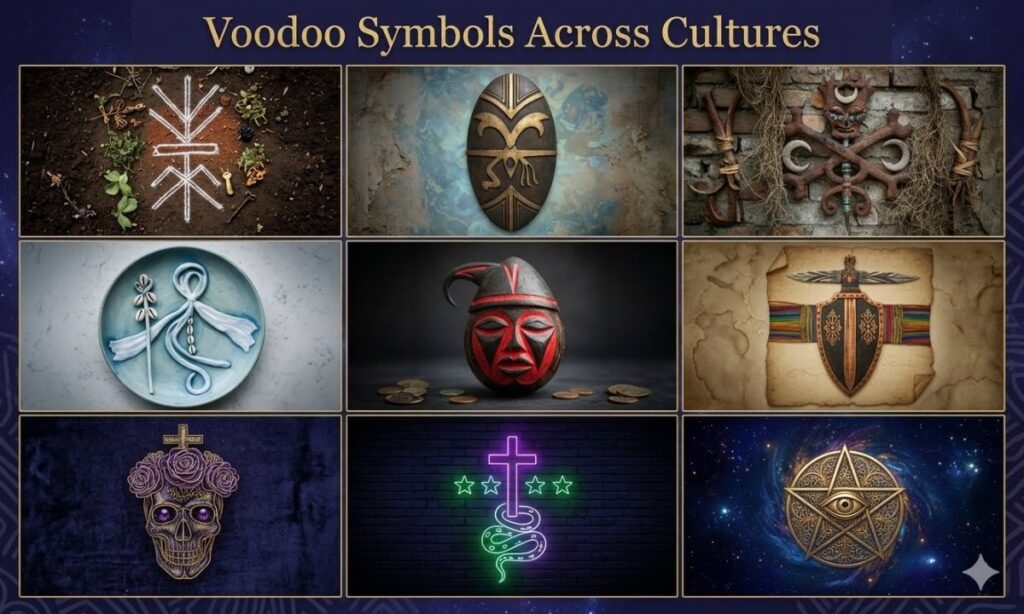
The roots of all Vodou symbolism lie in West Africa, particularly among the Fon, Ewe, and Yoruba peoples of modern Benin, Togo, and Nigeria. Sacred symbols there were woven into agriculture, healing, governance, and daily spiritual practice. They were not exotic mysteries — they were functional, communal, and deeply embedded in social life.
Haiti
In Haiti, African spiritual systems merged with Catholic imagery through a process called syncretism. Saints became visible faces for Lwa that could not be openly worshipped. Papa Legba aligned with Saint Peter. Erzulie Freda reflected the Virgin Mary. This was not spiritual compromise — it was strategic survival that allowed an entire cosmology to persist through centuries of oppression.
Louisiana
New Orleans became the American center of Voodoo practice, shaped by Haitian migration and the influence of legendary practitioners like Marie Laveau. Louisiana Voodoo blended Haitian veves with Hoodoo folk magic, Indigenous herbalism, and Catholic devotional practices. The visual symbols adapted but retained their spiritual core.
Caribbean and Brazil
Related traditions flourished across the Caribbean and South America. Santería in Cuba, Candomblé in Brazil, and the 21 Divisions in the Dominican Republic all use sacred markings with similar spiritual function to veves — though visually distinct. The underlying principle is consistent: symbols channel divine energy and invite sacred presence.
Modern Global Spirituality
Today, voodoo symbols appear on every continent. Some people engage with them through genuine spiritual practice, respecting their sacred origins. Others incorporate them into art, fashion, and design. As global interest in African diaspora spirituality grows, so does the responsibility to engage with these symbols thoughtfully and honestly.
Voodoo Symbols in Art, Movies and Pop Culture
Hollywood has long misrepresented voodoo symbols as instruments of dark magic. Films reduced a complex spiritual system to horror tropes — zombie dolls, hexes, and sinister ceremonies. This distortion served colonial and racist narratives that sought to delegitimize African spiritual traditions.
Contemporary artists, scholars, and practitioners are actively reclaiming the beauty and integrity of these symbols. Veves appear today in:
- Haitian fine art and textile work celebrating cultural heritage
- Tattoo culture among people seeking protection or spiritual connection
- Academic research into African diaspora religious history
- Fashion and jewelry designs inspired by sacred geometry
- Museum exhibitions exploring Vodou’s role in Haitian independence and identity
When approached with cultural honesty, voodoo symbols in modern art become acts of remembrance and celebration. When used carelessly, they perpetuate the very myths that were designed to erase them.
Spiritual and Dream Meaning of Voodoo Symbols
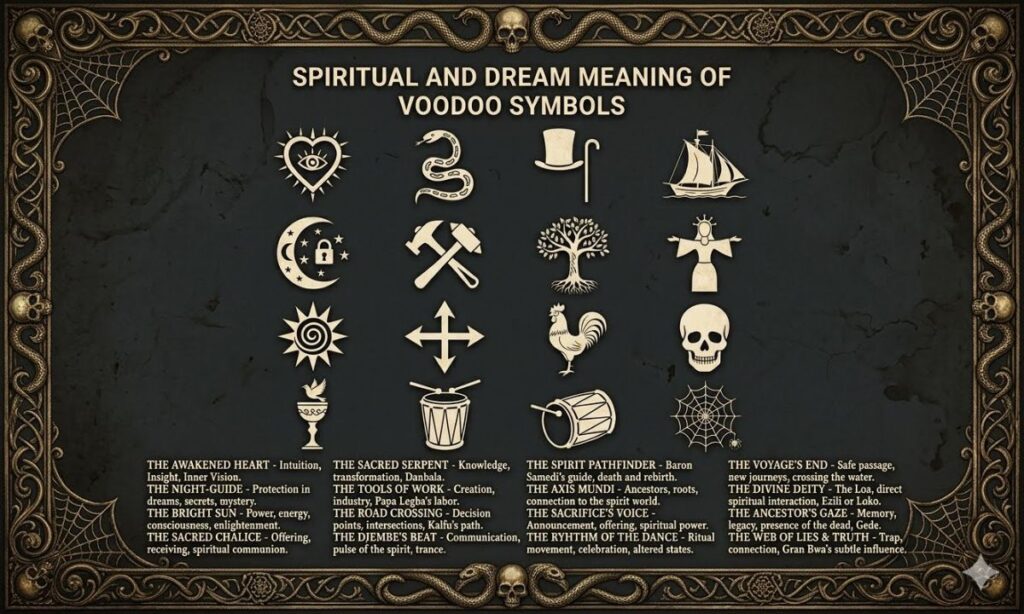
Seeing voodoo symbols in dreams often signals spiritual awakening, unresolved emotional energy, or an invitation to deeper self-examination. Interpretations vary by symbol:
- A crossroads veve may signal a major life decision approaching
- The serpent of Damballa may indicate personal transformation or healing
- Baron Samedi’s cross appearing in dreams often marks an ending that leads to necessary new beginnings
- Erzulie’s heart may surface during periods of emotional hunger or relational healing
In meditation, practitioners and spiritual seekers sometimes report naturally visualizing geometric patterns resembling veves. In Vodou understanding, the symbol without sincere intention is only powder on the ground. With intention, it becomes a living spiritual act.
Positive vs Negative Meaning
Positive Meaning
- Healing and physical restoration
- Protection from harm and negative energy
- Attraction of love and meaningful connection
- Guidance through crossroads and major decisions
- Restoration of connection with ancestors
- Spiritual clarity and community belonging
Negative Interpretation
Much of the negative perception surrounding voodoo symbols originates outside the tradition itself. Colonial missionaries portrayed African spiritual practices as demonic to justify oppression. Hollywood amplified those distortions for entertainment. The symbols themselves carry no inherent malice — meaning emerges from intention, knowledge, and context.
Why Humans Are Attracted to Voodoo Symbols
People are drawn to voodoo symbols for reasons that go beyond curiosity. These designs combine sacred geometry, cultural storytelling, ancestral memory, and emotional depth in a single visual form. They feel ancient because they are — and they feel powerful because generations of sincere practitioners invested their faith into them.
There is also the psychological pull of engaging with something once labeled forbidden. When people explore voodoo symbols, they are often searching for spiritual meaning outside conventional frameworks, seeking connection to their own ancestral roots, or simply recognizing that the unseen world still speaks through signs and shapes. At their core, voodoo symbols remind us that faith does not require words to be real — sometimes it only needs a careful hand, a clear intention, and a line drawn in the dust.
Frequently Asked Questions About Voodoo Symbols
Are voodoo symbols evil?
No. Voodoo symbols are sacred spiritual tools within Haitian Vodou. The negative reputation comes primarily from colonial propaganda and Hollywood stereotyping, not from the tradition itself.
What are veves in voodoo?
Veves are ceremonial drawings that serve as spiritual signatures for specific Lwa spirits. They are drawn during rituals to invite those spirits into the ceremony and focus their energy.
Can anyone draw voodoo symbols?
While anyone can copy a veve’s design, traditional practice holds that they should be drawn by trained practitioners within a sacred ritual context. Drawing one casually or without understanding is considered spiritually disrespectful.
What does the voodoo cross mean?
In Vodou, the cross typically represents crossroads — the point where the human and spirit worlds intersect. It is most closely associated with Papa Legba and carries no direct relation to suffering as in Christian symbolism.
Are voodoo symbols used for protection?
Yes. Many veves — particularly those of Ogou Feray and Marasa — are specifically invoked for protection against negative energy, spiritual harm, and physical danger.
Conclusion
Voodoo symbols are not relics of fear — they are living records of faith, endurance, and spiritual intelligence. Each veve drawn in cornmeal carries the weight of an entire people’s refusal to let their beliefs be erased. These signs survived the Middle Passage, colonial suppression, and centuries of misrepresentation because the truth they encode cannot be destroyed by those who do not understand it.
When you look at a voodoo symbol now, you are no longer seeing mystery alone. You are seeing history, psychology, cultural resilience, and sacred art woven into a single deliberate line. These symbols shaped the invisible world of millions — and through that world, the visible one too.

Steve Carell writes simple Symbol Meanings articles on primemegzine.com, helping readers easily understand signs, symbols, and hidden meanings.