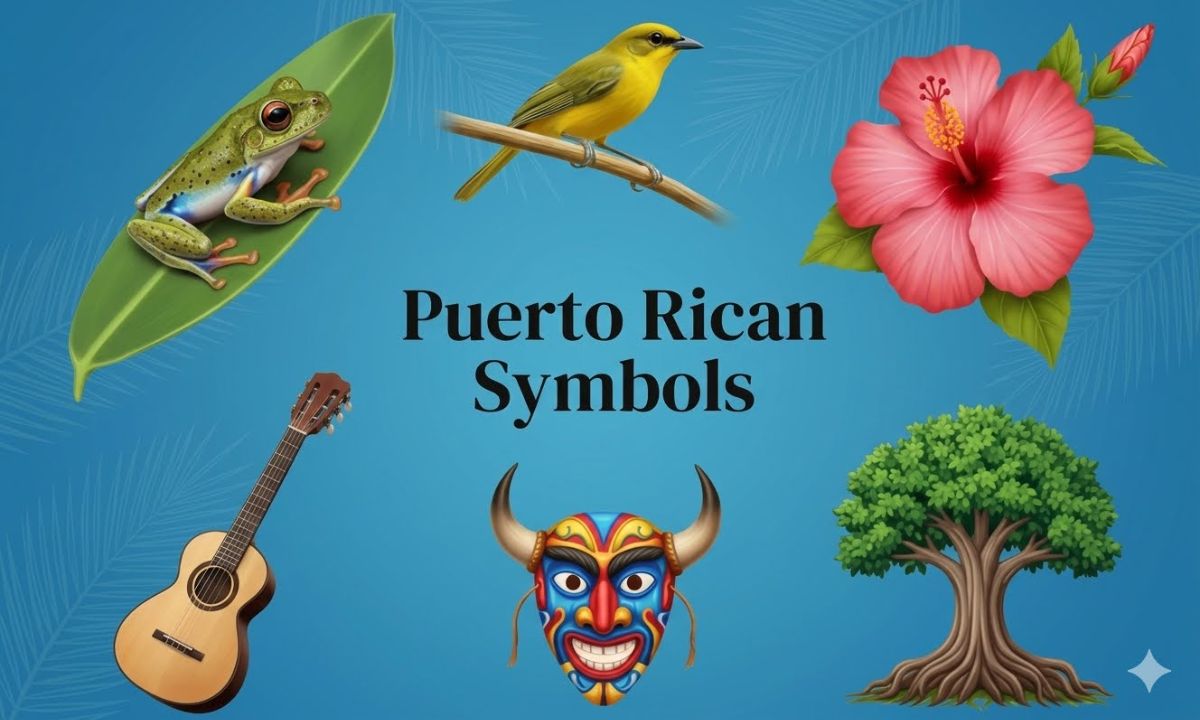
Puerto Rico is rich in history, culture, and traditions that make the island truly unique. Its symbols tell powerful stories about the people, their heritage, and the spirit that has shaped Puerto Rican identity for generations.
In this guide, you’ll discover 46+ Puerto Rican symbols that reveal the island’s true soul. From national icons and cultural traditions to nature and folklore, each symbol reflects the pride, resilience, and beauty of Puerto Rico.
What Are Puerto Rican Symbols?
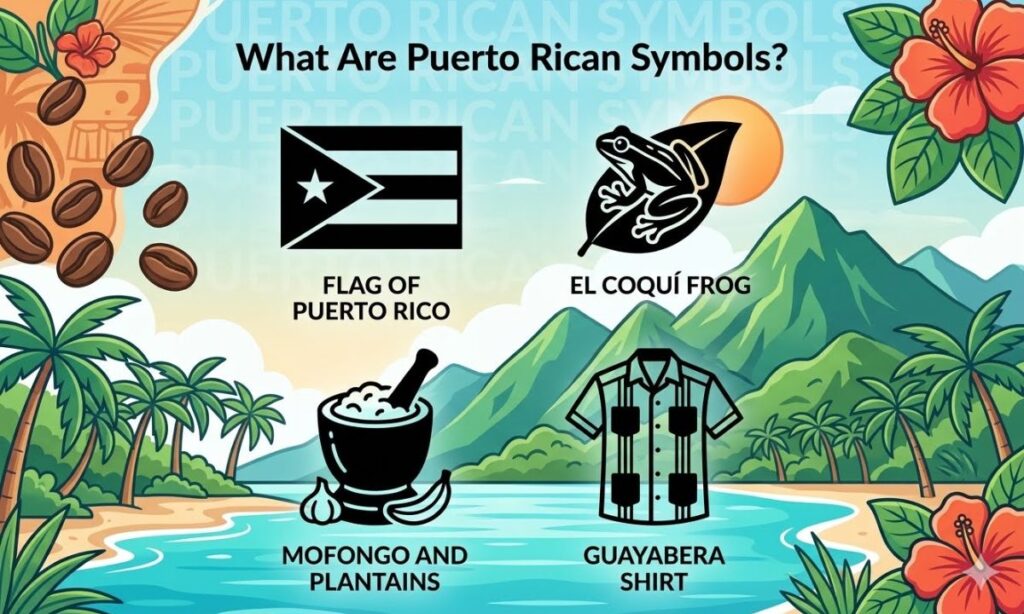
Puerto Rican symbols are visual, cultural, and spiritual expressions that reflect the island’s layered identity. They draw from three major roots: the Taíno indigenous tradition, Spanish colonial influence, and African heritage. Each layer contributed something distinct, and together they form a symbolic vocabulary unlike any other in the Caribbean.
The Taíno people carved petroglyphs into stone and cave walls as far back as 5,000 BC, representing their gods (zemís), natural forces, and community stories. When Spanish colonizers arrived in the 15th century, crosses, coats of arms, and royal emblems entered the cultural landscape. African traditions later added rhythm, spiritual practice, and symbols of endurance and freedom.
Today, these symbols appear in tattoos, murals, jewelry, festivals, and everyday life. They are not decoration. They are declarations of identity.
Puerto Rican Symbols And Their Cultural Meanings
Puerto Rican Symbols And Meanings
Understanding Puerto Rican symbols means looking beyond their surface appearance. Each one carries emotional, historical, and spiritual weight.
| Symbol | Core Meaning | Cultural Origin |
| Coquí Frog | Home, pride, identity | Taíno / National |
| Taíno Sun (Guey) | Life, cosmic energy, divine power | Taíno indigenous |
| Puerto Rican Flag | Freedom, unity, sacrifice | Nationalist movement |
| Hibiscus (Flor de Maga) | Natural beauty, femininity | National flower |
| Taíno Spiral | Continuity, cosmic cycles | Taíno indigenous |
| Royal Palm | Dignity, resilience | National tree |
| Coquí Taíno Symbol | Ancestral connection, fertility | Taíno / contemporary |
| Atabey Frog Figure | Fertility, water, the divine feminine | Taíno deity |
Puerto Rican Symbols Tattoos
Tattoos are one of the most personal ways Puerto Ricans carry their heritage. Popular designs include the coquí frog, the Taíno sun wheel, the flag, and geometric tribal patterns. Each tattoo choice reflects a deeper story — a connection to ancestors, a sense of belonging, or a statement made far from the island.
People raised in diaspora communities, particularly in New York, New Jersey, and Chicago, often use tattoos as a way of anchoring themselves to Borikén. A coquí on the wrist or a Taíno sun on the shoulder is not just body art. It is a permanent claim of identity.
Taino Symbols And Meanings
Taíno symbols were not simply decorative. Each carving served a purpose — religious, ceremonial, or communicative. Defining exact meanings remains challenging because accurate written records were never kept, and much of the culture was destroyed by European colonization. What survives comes from petroglyphs found across Puerto Rico, the Dominican Republic, Cuba, and other Caribbean islands.
Key themes found across Taíno symbols include:
- Zemís — sacred figures representing gods, ancestors, and natural forces
- Agricultural cycles — fertility, rain, and harvest
- Spiritual protection — carved objects believed to guard communities
- Cosmic connections — the relationship between sun, moon, stars, and human life
Puerto Rican Symbols Copy And Paste
For those looking to use Puerto Rican cultural icons in digital spaces, popular options include the Puerto Rican flag emoji 🇵🇷, sun symbols ☀️, and tribal-style graphics available through design platforms. These are widely used on social media to express pride, cultural solidarity, and identity, especially among the Puerto Rican diaspora.
Puerto Rico Taino Symbols
Puerto Rico Taino Symbols Tattoos
Taíno-inspired tattoos blend ancient spiritual imagery with modern tattooing techniques. Common design elements include:
- The Guey (sun wheel) — a circular face with radiating lines, considered the most tattooed Puerto Rican symbol in the US diaspora
- Atabey — the mother goddess, often shown with the body of a woman and the legs of a frog
- The coquí figure — a stylized geometric frog from ancient petroglyphs
- Spiral motifs — representing cosmic energy and life cycles
- Tribal seals — used historically by Taíno Caciques (chiefs) to represent lineage and authority
Anyone choosing a Taíno tattoo should take time to understand its meaning. These symbols carry real cultural weight, and wearing them with knowledge makes the art more respectful and meaningful.
Famous Symbols That Represent Puerto Rico
Taino Sun Symbol Meaning
The Taíno sun, known as Guey, is one of the most recognized indigenous symbols of Puerto Rico. It is typically depicted as a circular face surrounded by radiating lines, carved into stone across ceremonial sites. According to Taíno legend, the sun and moon were born from the same cave, and the sun was seen as the source of life, energy, and divine order.
Today, the Guey appears in art, jewelry, tattoos, and cultural events. Its ancient origin — predating Spanish arrival by over 1,000 years — gives it deep authority as a symbol of indigenous pride and ancestral wisdom.
Puerto Rico Symbol Frog
The coquí (Eleutherodactylus coqui) is arguably Puerto Rico’s most beloved symbol. This small tree frog produces a two-toned call — “ko-KEE” — that fills the island’s nights with sound. There are currently 17 known coquí species on the island, most of them brown or green, all of them loud.
What makes the coquí remarkable is its biology and its mythology together. It skips the tadpole stage entirely, hatching fully formed from eggs. Puerto Ricans say the coquí only truly sings in Puerto Rico — legend holds it dies of sadness elsewhere. When Puerto Ricans want to express their nationality, they say: “Soy de aquí como el coquí” — “I’m from here like the coquí.”
Puerto Rican Symbols Toa
The Toa symbol carries one of the most emotionally resonant stories in Taíno mythology. According to legend, the god Guahoyona abducted all women from the island, leaving men to care for the children. Crying out “toa, toa” — the Taíno word for mother — the children could not be consoled. The men, helpless, were turned into frogs. The symbol is a reminder of love, loss, and the unbreakable bond between people and their origins.
Taino Puerto Rican Symbols
Taíno symbols were found carved into caves, rocks, and ceremonial objects across Puerto Rico. Sites like Cagüana in Utuado preserve some of the most significant petroglyphs on the island. In 2022, archaeologists achieved a major milestone by successfully dating pre-Hispanic rock art for the first time, using images found in caves on Mona Island, a sacred Taíno spiritual site.
Puerto Rican Tattoos
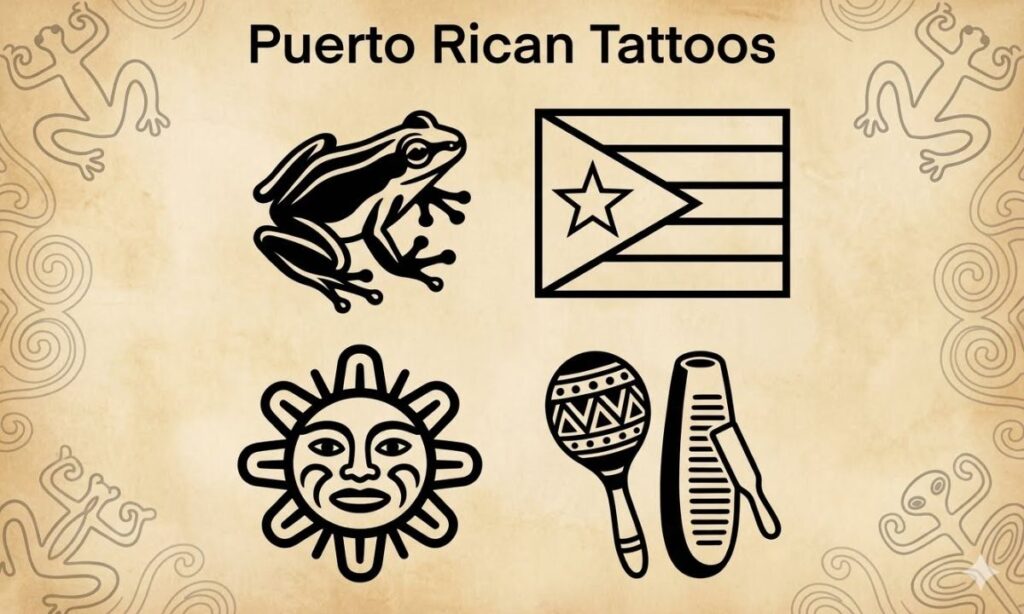
Puerto Rican tattoos blend cultural pride with personal storytelling. The most popular designs include:
- Puerto Rican flag tattoos — a declaration of national identity
- Coquí frog tattoos — representing home, roots, and resilience
- Taíno sun tattoos — honoring indigenous ancestry
- Hibiscus flower tattoos — celebrating natural beauty and femininity
- Tribal pattern tattoos — connecting to pre-Columbian heritage
Puerto Rican Taino Symbols
Taíno communities used symbols in every aspect of life — from ritual ceremonies and agricultural practices to storytelling and governance. The Great Seal, for example, was etched on a rock around 900 BC and depicted two branches surrounded by 24 leaves from the sacred Cojobana tree. It served as the official badge of authority for the tribal Cacique, representing blood lineage and leadership.
Puerto Rico Symbols
Symbols Of Puerto Rico
Puerto Rico’s most recognized national symbols include:
- La Bandera — the flag, with five red and white stripes, a blue triangle, and a white star
- El Coquí — the national frog
- Flor de Maga — the national flower (Thespesia grandiflora), a deep crimson hibiscus endemic to the island
- La Palma Real — the royal palm, national tree
- El Reinita — the Puerto Rican stripe-headed tanager (Spindalis portoricensis), the national bird
- La Borinqueña — the national anthem, which incorporates the Taíno name for the island, Borikén
Puerto Rican Protection Symbols
Several Taíno symbols were specifically associated with protection. Zemí figures were carved from stone, wood, or bone and placed in homes and ceremonial spaces to guard against negative forces. The conch shell was used not just as a communication tool during hunts but also as a protective and spiritual object. Certain petroglyphs found at sacred sites are believed to have served as spiritual boundaries, marking protected land.
Traditional Puerto Rico Symbols And National Identity
Things That Represent Puerto Rico
Beyond formal national symbols, Puerto Rico’s cultural identity is expressed through:
- Bomba and Plena music — rooted in African heritage
- Vejigante masks — colorful papier-mâché creations from Loíza and Ponce festivals
- Coffee and plantain culture — agricultural identity
- The phrase “Boricua” — derived from Borikén, the Taíno name for the island, used as a proud self-identifier
- Salsa music and dance — born from Puerto Rican communities in New York
Puerto Rico Symbols And Meanings
At their core, Puerto Rican symbols serve three purposes: they preserve history, they build community, and they assert identity. For Puerto Ricans living on the mainland or abroad, these symbols become anchors. They transform a flag necklace, a coquí tattoo, or a Taíno sun pendant into something far more than an accessory.
Puerto Rico National Symbols
| National Symbol | What It Represents |
| Flag | Unity, freedom, sacrifice |
| Coquí | Island identity, home, Boricua pride |
| Flor de Maga | Natural beauty, endemic pride |
| Royal Palm | Resilience, dignity |
| Reinita (tanager) | Biodiversity, island spirit |
| La Borinqueña | Indigenous heritage, cultural continuity |
Puerto Rico Symbol
If one symbol had to represent all of Puerto Rico, most would choose the coquí. It appears in children’s books, fine art, restaurant names, tourism logos, baby shower decorations, and national campaigns. Its simple, recognizable shape makes it the most versatile icon in Puerto Rican cultural life.
Deep Symbolic Meaning
Puerto Rican symbols work on multiple levels simultaneously.
Spiritually, they connect to divine forces, ancestral wisdom, and the unseen world. Taíno zemís were believed to carry the power of gods and protect those who honored them.
Psychologically, symbols like the coquí trigger deep emotional responses — nostalgia, belonging, and pride — especially for those far from the island. A Puerto Rican in Chicago hearing a coquí recording feels something that words cannot fully describe.
Culturally, these symbols tell a story of survival. Puerto Rico has survived colonization, hurricanes, economic crisis, and political uncertainty. Its symbols have survived alongside it — adapting, enduring, and growing more meaningful with each generation.
Types and Variations of Puerto Rican Symbols
The Coquí Frog
Visual: A small round-eyed tree frog, depicted in both realistic and geometric styles. Meaning: Home, pride, and the irreplaceable voice of the island. Found in: Folklore, music, tattoos, merchandise, and the Taíno symbol tradition.
The Sun Symbol (Taíno Sun)
Visual: A circular face with radiating lines carved in stone. Meaning: Life, divine energy, and the power of the cosmos. Found in: Petroglyphs at Cagüana, jewelry, tattoos, and contemporary art.
The Puerto Rican Flag
Visual: Five red and white stripes, a blue equilateral triangle, and a single white star. Meaning: Each element tells part of the national story. The red stripes represent the blood of warriors; the white stripes, individual liberty; the blue triangle, the three branches of government and the coastal waters; the white star, the island itself. Found in: Government, protests, festivals, clothing, and diaspora communities worldwide.
The Coquí Taíno Symbol
Visual: A stylized geometric frog built from lines and angles, distinct from naturalistic coquí drawings. Meaning: A direct bridge between Taíno spirituality and modern Puerto Rican identity. The Taíno depicted the coquí as a symbol of life and fertility. Found in: Ancient petroglyphs, contemporary tattoos, and cultural artwork.
The Hibiscus Flower
Visual: A large, striking flower with crimson or deep red petals — specifically the Flor de Maga (Thespesia grandiflora), endemic to Puerto Rico. Meaning: Natural beauty, femininity, and pride in the island’s unique biodiversity. Found in: Gardens, fashion, paintings, jewelry, and national branding.
The Taíno Spiral
Visual: A swirling circular pattern, recurring across petroglyphs and pottery. Meaning: Cosmic energy, the endless cycle of life, and the connection between water, sky, and earth. In Taíno belief, the spiral also represented sweet freshwater — a vital resource. Found in: Rock carvings throughout Puerto Rico, ceremonial pottery, and modern symbolic art.
Puerto Rican Symbols Across Cultures
Puerto Rican symbols do not exist in isolation. They carry traces of every civilization that shaped the island.
In Taíno culture, symbols were sacred and inseparable from religious life. Every carving connected to a deity, a story, or a spiritual practice.
In Spanish colonial culture, religious iconography merged with indigenous forms. Crosses, saints, and royal crests layered over — and sometimes replaced — older Taíno expressions.
African traditions introduced symbols of resilience through music, rhythm, and spiritual practice. Bomba drumming, vejigante masks, and Afro-Caribbean religious imagery became part of Puerto Rico’s symbolic landscape.
In modern diaspora culture, these symbols have taken on new urgency. In New York, Miami, and cities across the US, Puerto Rican symbols serve as visible declarations of cultural survival in a world that often pressures assimilation.
Puerto Rican Symbols in Art, Movies and Pop Culture
Puerto Rican symbols appear across creative media in powerful ways:
- In films and television, a coquí sound in the background or a Puerto Rican flag in a scene adds immediate emotional authenticity
- In visual art, Taíno petroglyphs and vibrant island colors inspire murals and gallery works that blend pre-Columbian heritage with contemporary expression
- In music, symbols are embedded in lyrics, album art, and stage aesthetics — from salsa to reggaeton to indie Puerto Rican artists reclaiming indigenous identity
- In fashion, the flag, coquí, and Taíno motifs appear on clothing, sneakers, and accessories worn as cultural statements
- In tattoo culture, Puerto Rican designs rank among the most requested Caribbean-inspired tattoos globally
Spiritual and Dream Meaning of Puerto Rican Symbols
When these symbols appear in dreams or meditation, many people interpret them as meaningful messages:
- A coquí in a dream often signals longing for home or a need to reconnect with one’s roots and true self
- The Taíno sun appearing in a dream may represent clarity, a new beginning, or something hidden coming into light
- Spirals in dreams frequently suggest personal transformation — a reminder that growth is continuous, even when the path is unclear
- Symbols of protection, such as zemí figures, may appear during times of stress as reminders of ancestral support
Positive vs Negative Meaning
Puerto Rican symbols carry both light and shadow, reflecting the full depth of human experience.
On the positive side, they represent pride, resilience, beauty, belonging, and the triumph of cultural survival. They inspire people to embrace who they are and where they come from, regardless of where life has taken them.
On the more complex side, some symbols carry the weight of colonization and loss. The flag itself has a complicated history — it was once illegal to display it under US colonial law. For some, these symbols are reminders of ongoing political struggles and unresolved questions of sovereignty and autonomy.
This duality is not a weakness. It makes the symbols richer and more honest.
Why Humans Are Attracted to Puerto Rican Symbols
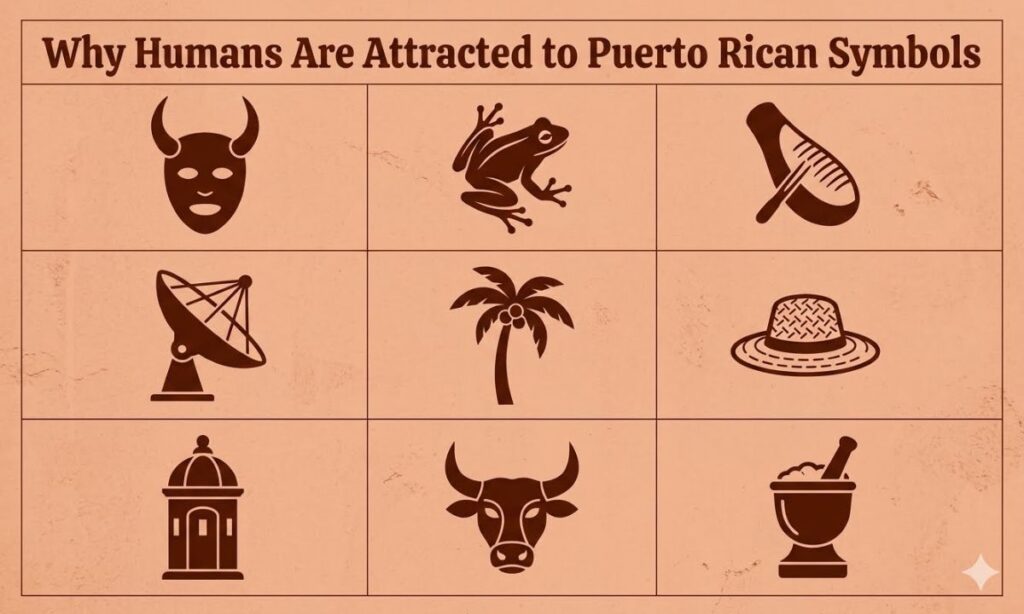
Symbols simplify what language struggles to contain. Puerto Rican symbols, in particular, resonate because they carry emotional density — they represent belonging in a world where many people feel rootless.
Psychologically, they provide grounding. A person far from the island can hold a coquí pendant and feel connected to something larger than themselves. Emotionally, they trigger memory — family, food, landscape, language, and the feeling of being truly home.
There is also something universally human about these symbols. Their themes — survival, love, connection to nature, the divine, community — transcend cultural borders and speak to shared experience.
FAQs About Puerto Rican Symbols
What is the most important Puerto Rican symbol?
The Puerto Rican flag is widely considered the most important symbol, representing national unity, freedom, and the island’s enduring spirit. The coquí frog runs a very close second for emotional resonance.
What does the coquí symbolize in Puerto Rico?
The coquí symbolizes home, pride, and belonging. Its call is so tied to the island that Puerto Ricans say it only truly sings in Puerto Rico — legend holds it dies of sadness anywhere else.
Are Puerto Rican symbols spiritual?
Yes. Many symbols, especially those rooted in Taíno culture, carry deep spiritual meaning connected to gods, natural forces, ancestral protection, and the cosmic order.
Why are Taíno symbols important?
Taíno symbols connect modern Puerto Ricans to their indigenous roots, preserving a cultural memory that colonization tried to erase. They are acts of historical survival as much as artistic expression.
Can anyone use Puerto Rican symbols in tattoos?
Yes, but approaching them with genuine knowledge and respect matters. These symbols carry real cultural and historical significance, and understanding what you wear makes the expression more meaningful for both the wearer and the community.
Conclusion
Puerto Rican symbols are living history. They carry the voices of Taíno ancestors, the courage of independence fighters, the rhythm of African traditions, and the quiet pride of a people who have refused to disappear. From the coquí’s nighttime song to the Guey sun carved into ancient stone, these symbols remind the world that Puerto Rico is not just a place — it is a feeling, a memory, and a declaration that endures.
When you understand what these symbols mean, you understand something essential about human resilience: that identity, even when tested, finds a way to survive and speak.

Steve Carell writes simple Symbol Meanings articles on primemegzine.com, helping readers easily understand signs, symbols, and hidden meanings.