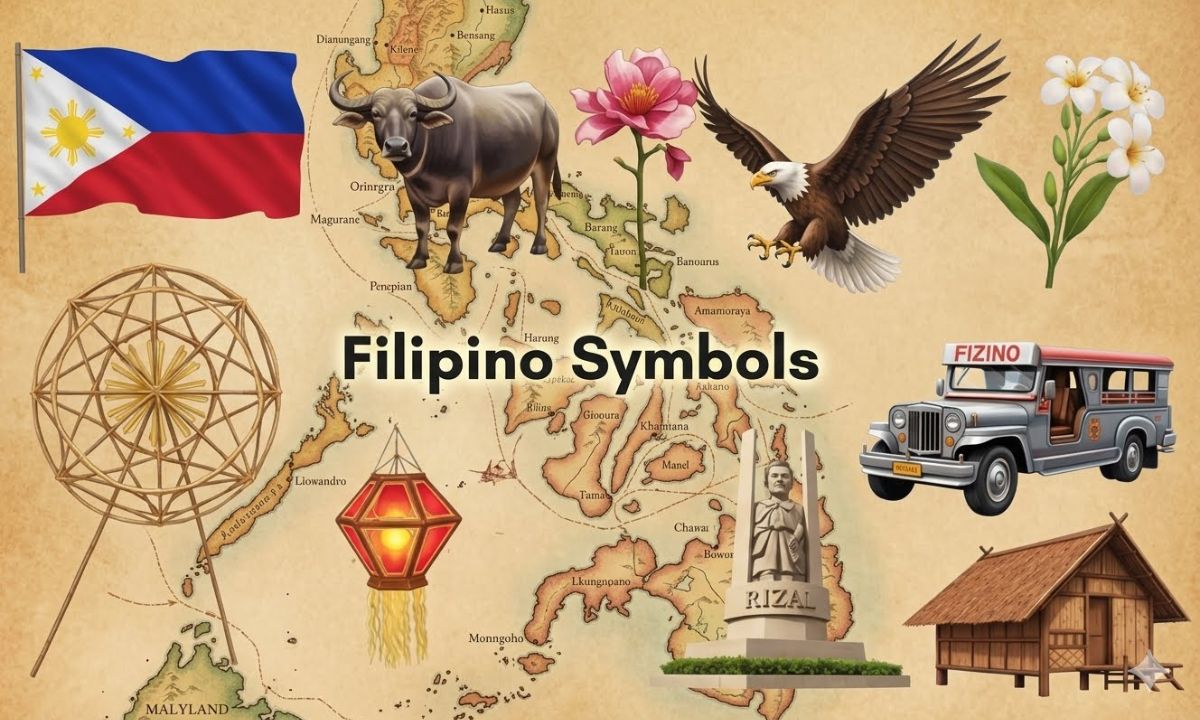
The Philippines is rich in culture, history, and tradition. Many Filipino symbols have been passed down through generations, carrying deep meanings that reflect beliefs, values, nature, and everyday life. Some symbols are well known, while others remain hidden in folklore, art, and ancient customs.
In this guide, you’ll discover 60+ mysterious Filipino symbols and their hidden meanings. From traditional patterns and mythical creatures to spiritual signs and cultural icons, these symbols reveal fascinating stories that many people have never noticed before. Their meanings offer a unique glimpse into the heart of Filipino heritage and identity.
What Are Filipino Symbols?
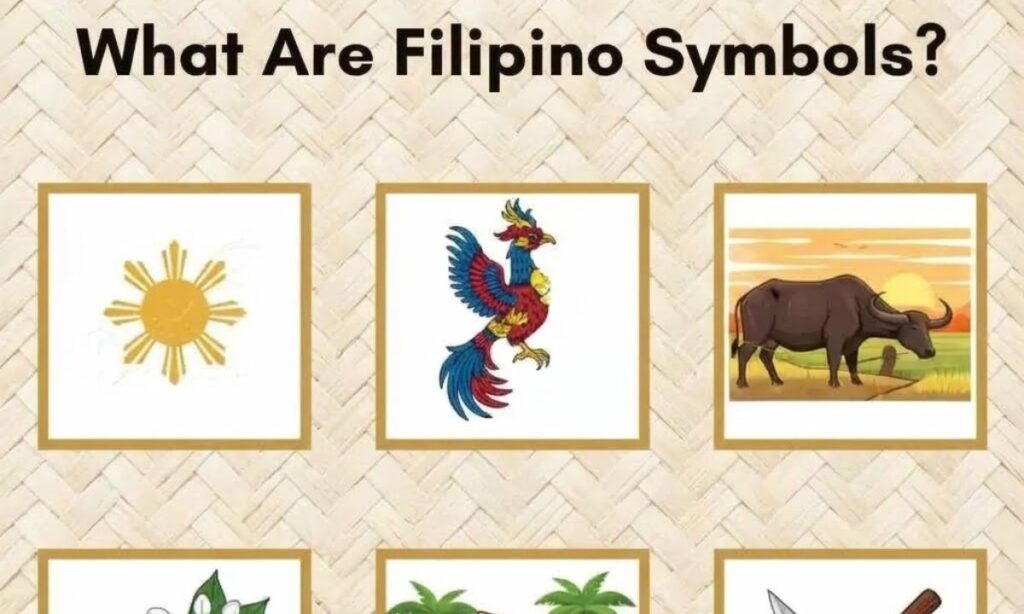
Filipino symbols are visual, cultural, and spiritual representations rooted in the country’s history, beliefs, and collective identity. Long before written language arrived on the islands, early Filipinos communicated meaning through markings on skin, patterns on woven cloth, carvings in wood, and shapes etched into jewelry.
These symbols were not decorative. They served real purposes — marking social rank, offering spiritual protection, honoring ancestors, and connecting people to the natural world. Over time, colonization by Spain and later American influence added new layers to the visual language of the Philippines, blending Christian imagery with animist traditions.
Today, Filipino symbols act as cultural anchors. They appear in tattoos, national monuments, educational materials, fashion, and art, keeping identity alive across generations and across the diaspora.
Filipino Cultural Symbols And Their Meanings
Filipino symbols and meanings
Filipino symbols carry layered meanings shaped by geography, faith, tribal tradition, and colonial history. The sun represents freedom and hope. The bamboo symbolizes flexibility and strength. The carabao reflects hardworking rural life. Each symbol connects to a value deeply embedded in Filipino everyday experience — family loyalty, resilience, community spirit, and reverence for nature.
Filipino flag
The Philippine flag is among the most symbolically rich national flags in the world. Officially adopted on June 12, 1898, it features a white equilateral triangle containing a golden sun, three five-pointed stars, and two horizontal stripes — one blue and one red.
| Element | Symbolism |
| Blue stripe | Peace, truth, and justice |
| Red stripe | Patriotism and valor |
| White triangle | Equality and fraternity |
| Golden sun | Freedom and national sovereignty |
| Eight sun rays | The eight provinces that first rose against Spanish rule |
| Three stars | The three major island groups: Luzon, Visayas, Mindanao |
When the flag is displayed with blue on top, it signals peacetime. Red on top signals a state of war — a detail most people never notice.
Filipino symbols tattoos
Tattooing in the Philippines is one of the oldest recorded art forms in Southeast Asia. Spanish colonizers called the indigenous tattooed peoples of the Visayas “Pintados,” meaning painted ones. These tattoos were not fashion — they were earned. Warriors received marks after acts of bravery. Tribal rank, spiritual protection, and community belonging were all encoded into the skin.
Common motifs include:
- Sun and ray patterns — freedom and divine energy
- Crocodile and serpent designs — power and the spirit world
- Wave and water patterns — connection to the sea and islands
- Spear and blade symbols — warrior identity and courage
Today, the revival of traditional Filipino tattoo arts — particularly through masters like Whang-od of the Kalinga tribe — has become a global movement for cultural reclamation.
Filipino symbols letters
The most significant example of Filipino symbolic letters is Baybayin, an ancient Indic-derived script used across much of the Philippine archipelago before Spanish colonization. Unlike the Roman alphabet, Baybayin characters each represent a syllable rather than a single sound.
Baybayin was written on perishable materials like bamboo and leaves, which is why so few original documents survive. What remains appears on copper plates, manuscripts, and colonial-era records. Today it has been revived through art, tattoos, product design, and growing calls to include it in national education.
Philippines symbols and meanings
Beyond the flag, the Philippines recognizes a rich array of national symbols, each selected to represent the country’s natural beauty, cultural character, and shared values. These symbols are taught in schools and appear throughout public life, from government seals to provincial logos.
National Symbols Of The Philippines
What are the 10 national symbols of the Philippines
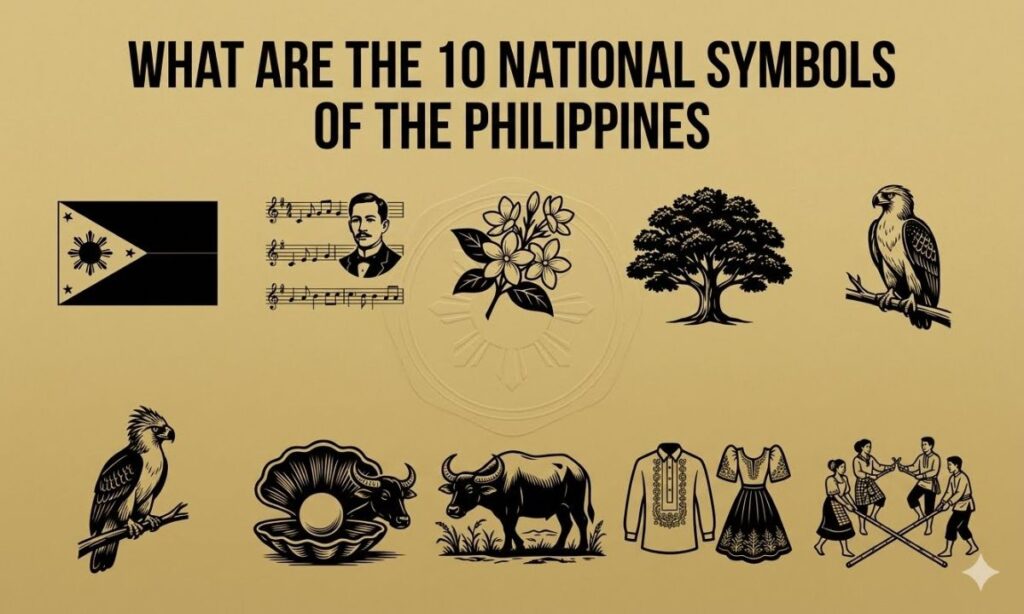
The Philippines has twelve officially recognized national symbols established through law. Here are the core ones:
| Symbol | What It Represents |
| Philippine flag | National sovereignty and independence |
| Philippine eagle | Strength, freedom, and ecological heritage |
| Narra tree | Resilience and natural beauty |
| Sampaguita flower | Purity, simplicity, and humility |
| Arnis | National martial art and cultural discipline |
| Philippine pearl | Natural wealth and rarity |
| Carabao (widely recognized) | Hard work and the farming community |
| Mango (widely recognized) | Richness of Philippine agriculture |
| Anahaw leaf (widely recognized) | Peace, hospitality, and resilience |
| Bahay-kubo (nipa hut) | Bayanihan spirit and communal living |
Philippine national symbols PDF
Official documents listing Philippine national symbols with descriptions and images are widely available from the Department of Education and the Official Gazette of the Philippines. These PDFs are standard educational references used in schools nationwide and include legal citations for each officially enacted symbol.
Philippines national bird
The Philippine Eagle (Pithecophaga jefferyi) is the national bird and one of the largest, most powerful eagles on Earth. It lives primarily in the rainforests of Mindanao, Leyte, Samar, and Luzon. Critically endangered, it represents not only national pride and sovereignty but also the urgent need to protect what remains of the country’s old-growth forests. Its wingspan can reach over two meters, and it is sometimes called the “monkey-eating eagle.”
Philippine national symbols with pictures and description
Visual learning materials for Philippine national symbols are available through the Official Gazette, DepEd educational modules, and the National Museum of the Philippines. These resources pair images with descriptions to help students connect visual identity with historical and cultural meaning.
National tree of the Philippines
The Narra (Pterocarpus indicus) was declared the national tree by virtue of Executive Order No. 652 in 1934. Prized for its beautiful golden-red hardwood and sweet scent, the Narra is native to the Philippines and Southeast Asia. It symbolizes the durability and quiet strength of the Filipino character — deeply rooted, resistant to pressure, and enduring across centuries.
Ancient And Traditional Filipino Symbols
Ancient Filipino symbols
Pre-colonial Filipino communities developed rich symbolic vocabularies tied to animism — the belief that all things in nature possess a living spirit. Ancient symbols appeared in burial rituals, warrior tattoos, agricultural ceremonies, and trade goods. These were not simply decoration; they were communication with the visible and invisible worlds simultaneously.
Filipino symbolism
At its core, Filipino symbolism reflects a worldview that places human beings in relationship with ancestors, nature spirits, and communal bonds. Symbolism in weaving patterns, for example, can encode genealogy, spiritual status, and tribal belonging in geometric form. A single T’nalak textile from the T’boli people carries stories only the weaver fully understands.
Traditional Filipino symbols
Traditional symbols vary significantly by region and ethnic group:
- Ifugao — bulul granary figures representing ancestral oversight of harvests
- Maranao — okir scrollwork and the Sarimanok bird
- Kalinga and Bontoc — geometric warrior tattoos
- Visayan — Pintados body tattoo traditions
- Tagalog — Baybayin script and coastal animist symbols
Filipino good luck symbols
Several symbols are traditionally associated with good fortune in Filipino belief:
- Sarimanok — the mythical Maranao bird said to bring prosperity to whoever encounters it
- Lingling-o — ancient jade fertility amulets worn as earrings, found at archaeological sites across the archipelago
- Sun motifs — warmth, abundance, and divine favor
- Sampaguita garlands — offerings believed to invite blessings
Filipino ancient symbols
Ancient Filipino symbols include the lingling-o jade ornament (10th–15th century), the okir scrollwork patterns of Mindanao, warrior tattoo markings of the Visayas, and the carved bulul rice god figures of the Ifugao. Each emerged from specific ecological and spiritual contexts, encoding beliefs about fertility, protection, and the afterlife.
Filipino indigenous symbols
Indigenous Filipino symbols reflect the diversity of over 100 ethno-linguistic groups across the archipelago. The T’boli’s T’nalak dreamweave patterns, the Yakan’s geometric textile codes, the Maranao’s royal okir carvings, and the Kalinga’s tattoo traditions each form a distinct symbolic language. Together they reveal a country far older and more layered than colonial history often acknowledges.
Filipino protection symbols
Protection symbols were embedded into daily life. Warriors wore tattooed designs believed to deflect harm. Homes were marked with carved symbols to ward off evil spirits. Amulets called anting-anting — often engraved with symbols, prayers, or Baybayin characters — were carried for personal protection. These practices blended indigenous animism with Spanish Catholic folk magic over centuries of contact.
Filipino Symbols Of Identity, Culture And Strength
Family Filipino symbols and meanings
Family is the central unit of Filipino society, and symbols of family emphasize interconnection and loyalty. Circular or interlocking patterns represent bonds that cannot be broken. The bahay-kubo nipa hut symbolizes bayanihan — the communal spirit of neighbors literally carrying a home together when a family needs to move. It is a symbol of mutual care and collective identity.
Filipino symbols for strength
Strength in Filipino symbolism is rarely individual. It is communal, earned, and spiritual. Key strength symbols include:
- Sun rays — enduring light through hardship
- Eagle in flight — sovereignty and fearlessness
- Warrior tattoos — courage proven through action
- Bamboo — bending without breaking
Symbols that represent Filipino culture
- Jeepney — Filipino ingenuity and vibrant spirit, born from repurposed military vehicles
- Barong Tagalog — the formal male garment representing elegance and cultural dignity
- Parol (Christmas lantern) — hope, faith, and the uniquely Filipino celebration of Christmas
- Sampaguita — humility, purity, and the spirit of giving
Filipino symbols of strength
Ancient warrior cultures across the Philippines used bold, angular tattoo patterns as visible proof of strength. These were not decorative — each mark was earned. The Whatok tradition of the Butbut Kalinga, carried forward today by tattoo master Whang-od, represents one of the oldest living tattoo traditions in the world.
Filipino culture symbols
Culture symbols in the Philippines span official national emblems, indigenous tribal marks, and everyday items elevated to iconic status. The parol, jeepney, and bahay-kubo are as culturally powerful as any ancient symbol because they represent the living, evolving character of Filipino identity.
Filipino symbols culture
Filipino symbol culture is oral, visual, and tactile. Stories are told through weaving patterns, tattoos, carvings, and festivals. Culture is transmitted not only through books but through the hands — the weaver, the tattoo artist, the wood carver — keeping symbolic meaning alive in the body and in daily practice.
Indigenous Filipino symbols
Indigenous symbols carry the highest cultural density. They encode theology, ecology, genealogy, and ethics in visual form. Protecting and studying these symbols is now recognized as essential to cultural sovereignty — the right of indigenous peoples to define their own history and identity.
Symbols of Filipino identity
The strongest symbols of Filipino identity today blend ancient and modern:
- Baybayin script — reclaiming pre-colonial linguistic identity
- Philippine Eagle — pride in natural heritage
- Sarimanok — Mindanao’s presence in the national story
- Sun with eight rays — the revolutionary spirit of 1896
Symbols of Filipino culture
Filipino culture symbols ultimately point toward shared values: kapwa (shared identity with others), bayanihan (communal cooperation), utang na loob (debt of gratitude), and pagmamahal (deep familial love). Every symbol, from the humblest nipa hut to the soaring eagle, reflects one of these human commitments.
More Ancient And Cultural Filipino Symbols
Ancient Filipino symbols and meanings
| Symbol | Origin | Meaning |
| Bulul (Ifugao rice god) | Pre-colonial northern Luzon | Ancestral protection of harvests |
| Lingling-o jade | 10th–15th century archipelago trade | Fertility, protection, status |
| Pintados tattoos | Pre-colonial Visayas | Warrior rank and spiritual armor |
| Okir scrollwork | Mindanao Maranao culture | Life force and divine order |
| Baybayin characters | Pre-colonial Philippine lowlands | Literacy, identity, cultural memory |
Filipino cultural symbols
Cultural symbols are living artifacts. They change, survive, disappear, and return. The revival of Baybayin in modern Filipino graphic design and the global spread of Kalinga tattoo traditions through artists trained by Whang-od are proof that ancient symbols adapt without losing their core meaning.
Ancient Filipino symbols for strength
Ancient strength symbols drew from nature — eagles, crocodiles, and serpents — and from human achievement — earned warrior tattoos and battle-tested weapons. These were symbols that had to be lived, not simply displayed.
Filipino symbols for family
Family symbols often reference circular or interwoven forms, reflecting the unbreakable nature of kinship bonds. The concept of kapwa — that the self is not separate from others — makes family symbolism inseparable from community symbolism in Filipino culture.
Traditional Filipino symbols and meanings
Traditional symbols encode a philosophy of reciprocity: between people, between humans and nature, and between the living and the ancestors. They remind every generation that they are not the first — and carry responsibility to those who come after.
Old Filipino symbols for strength
Old strength symbols such as the Kalasag (indigenous shield) decorated with geometric protection patterns served both practical and spiritual purposes in battle. These designs are now being revived in contemporary Filipino art and tattoo culture.
Tagalog family Filipino symbols and meanings
In Tagalog culture, family symbols emphasize pagmamalasakit — deep caring and responsibility for one another. Common Tagalog family representations use sun imagery (warmth and nurturing) and interlocking ring or knot patterns (unbreakable bonds).
Common Filipino symbols
The most widely recognized Filipino symbols include:
- The sun and stars of the national flag
- Sampaguita flower
- Philippine Eagle
- Bamboo
- Sarimanok bird
- Baybayin script
- Narra tree
- Bahay-kubo
- Carabao
Filipino symbols and practices
Symbols are inseparable from practice. The pagmamano gesture (pressing an elder’s hand to the forehead) is itself a living symbol of respect. Pabitin at festivals, parol lanterns at Christmas, and pasyon chanting during Holy Week all encode symbolic meaning in action, sound, and ritual.
Warrior Filipino symbols
Warrior symbols in the Philippines are among the most visually powerful in Southeast Asia. From the geometric tattoos of the Kalinga to the flowing Maranao battle banners, Filipino warrior symbolism communicates courage, spiritual protection, and tribal belonging simultaneously.
Philippine Filipino symbols
Philippine symbols, when viewed as a whole, tell a story of a people who survived colonization, natural disaster, forced assimilation, and global migration — and still maintained a recognizable cultural soul. That resilience is the deepest meaning embedded in every Filipino symbol.
Ilocano ancient Filipino symbols and meanings
The Ilocano people of northern Luzon have their own rich symbolic traditions, including distinctive weaving patterns in abel cloth that encode family lineage and regional identity. Protective symbols and nature motifs appear in Ilocano woodcarving, jewelry, and ritual objects, representing prosperity, community protection, and connection to the agricultural land.
Deep Symbolic Meaning of Filipino Symbols
Spiritual Level
On a spiritual level, Filipino symbols connect the visible world to the unseen. Ancient Filipinos recognized spirits called anito — ancestral presences and nature deities — that inhabited trees, water, mountains, and carved figures. Symbols were not mere representations; they were invitations, shields, and bridges between worlds.
Many of these spiritual functions persist today in folk Catholicism, where pre-colonial protective practices blend with Catholic saint veneration, candle rituals, and pilgrimage traditions.
Psychological Level
Psychologically, symbols create belonging. For Filipinos living abroad — one of the largest diaspora communities in the world — cultural symbols are powerful emotional anchors. Seeing a parol in December, wearing Baybayin on skin, or hearing the name of a hometown tree triggers identity, memory, and continuity.
Symbols tied to warrior traditions and solar imagery also speak to inner resilience — the psychological capacity to survive, adapt, and continue.
Cultural Level
Culturally, Filipino symbols preserve knowledge that official history often overlooked or actively suppressed. They carry lessons about ecological stewardship, community ethics, spiritual humility, and the hard-won meaning of independence. Each symbol is a library in compressed form, available to anyone willing to look closely.
Types and Variations of Filipino Symbols
Sarimanok
A mythical bird of the Maranao people of Mindanao, the Sarimanok is depicted as a colorful rooster with ornate, fish-like tail feathers, often holding a fish in its beak or talons. It represents good fortune, divine blessing, and the balance between the earthly and spiritual realms. National Artist Abdulmari Imao brought the Sarimanok into the national cultural canon through his landmark brass sculptures at the Cultural Center of the Philippines. It remains one of the most visually striking and spiritually layered symbols in all of Filipino culture.
Sun and Stars of the Philippine Flag
Eight rays radiate from the golden sun, each one representing a province that took up arms against colonial rule in 1896: Manila, Cavite, Bulacan, Pampanga, Nueva Ecija, Bataan, Laguna, and Batangas. The three stars represent Luzon, Visayas, and Mindanao. This symbol does not simply represent a nation — it represents the specific act of courage that created one.
Anito Figures
Carved wooden or stone figures used in pre-colonial rituals across the archipelago, anito embodied ancestor spirits or nature deities. Regional variants include the bulul rice god figures of the Ifugao, which were ritually activated to protect harvests, and the taotao figures found in Luzon burial contexts. These carvings represent respect for lineage, the presence of the unseen, and the human need to make spiritual forces tangible.
Okir Patterns
Okir (also spelled ukkil) is the name for the flowing, plant-inspired geometric scroll designs found in Maranao and Tausug art across Mindanao and the Sulu Archipelago. These patterns appear on architectural elements, royal banners, jewelry, boats, and textiles. They express the belief that life is continuous and cyclical, that all things are connected through a flowing, unbreakable energy.
Baybayin Script
Baybayin is the pre-colonial script of the Philippine lowlands, an Indic-derived abugida in which each character represents a consonant-vowel combination. Used widely before Spanish colonization, it was documented by colonial friars and gradually displaced by the Latin alphabet. Today, Baybayin is experiencing a powerful revival as a symbol of cultural sovereignty — appearing in government signage proposals, tattoos, commercial design, and educational advocacy. Katipuneros, the revolutionary fighters of 1896, used Baybayin as a secret code on their garments, making it literally a symbol of resistance.
Filipino Symbols Across Cultures
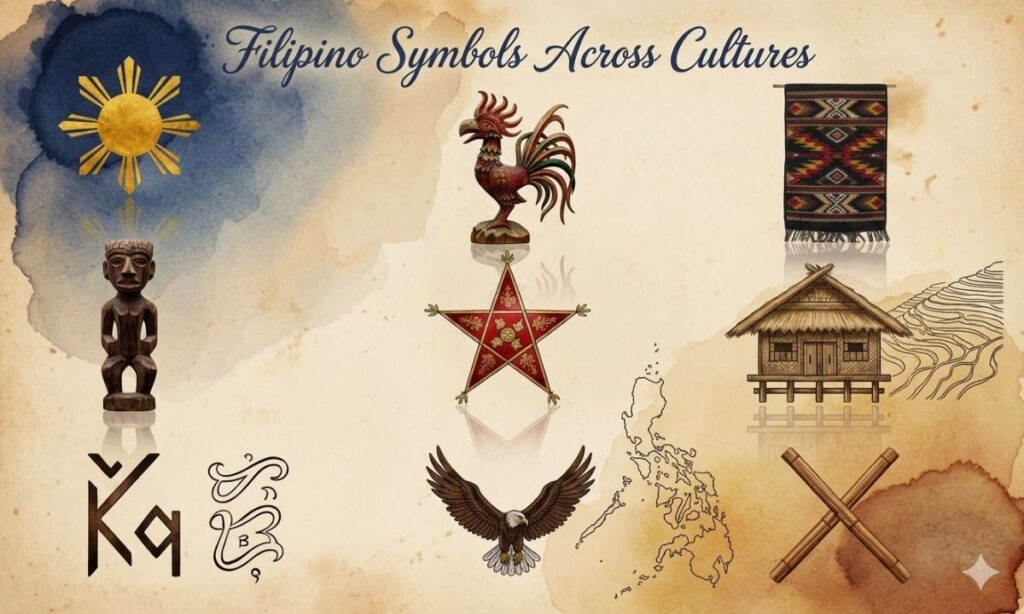
Filipino symbols have always been in dialogue with the wider world. Ancient trade routes connected the archipelago to India, China, Java, and the Malay Peninsula — and symbolic exchanges followed the goods. The lingling-o jade ornament traces to shared Austronesian cultural currents stretching from Taiwan to Indonesia.
During colonization, Spanish Catholic symbols fused with indigenous ones. Saints absorbed the protective functions of ancestral spirits. The cross merged visually and spiritually with solar symbolism.
In the modern global context, Filipino symbols in diaspora communities carry additional meaning — they are acts of cultural resistance against assimilation, reclaiming visibility in societies where Filipino identity is often invisible.
Filipino Symbols in Art, Movies and Pop Culture
Filipino painters from Fernando Amorsolo to contemporary artists use symbols like the sun, the rural landscape, and the mother figure to explore colonial trauma, postcolonial identity, and enduring hope. In cinema, directors embed symbolic colors, folklore references, and spatial imagery to communicate meaning beneath the surface narrative.
In tattoo culture, the global revival of Filipino tribal traditions — particularly Kalinga work by Whang-od and her descendants — has placed Filipino indigenous art on the world stage. In fashion, indigenous weaving patterns from the Cordillera, Mindanao, and the Visayas are being reclaimed by Filipino designers challenging colonial aesthetics.
Baybayin has entered mainstream graphic design, product packaging, and digital art, making an ancient script a contemporary cultural statement.
Spiritual and Dream Meaning of Filipino Symbols
Encountering Filipino symbols in dreams or during moments of spiritual reflection often signals a deeper communication with heritage and identity. A sun symbol may point toward awakening, inner clarity, or the beginning of an important chapter. Ancestral figures in dreams frequently represent guidance, unresolved family patterns, or the need to honor one’s roots. Water and wave motifs connect to emotional depth, adaptability, and the island geography that shapes Filipino psychology at a fundamental level.
Positive vs Negative Meaning
Filipino symbols carry both light and shadow. The sun represents freedom — but it also marks the suffering that freedom cost. Warrior tattoos celebrate courage — but they were earned through violence and loss. The flag flew during triumphant independence — and was suppressed during martial law.
This duality is not a contradiction. It is the honest complexity of a culture that has survived extraordinary pressure without losing itself. Filipino symbols hold grief and joy simultaneously, which is precisely why they remain emotionally powerful across generations.
Why Humans Are Attracted to Filipino Symbols
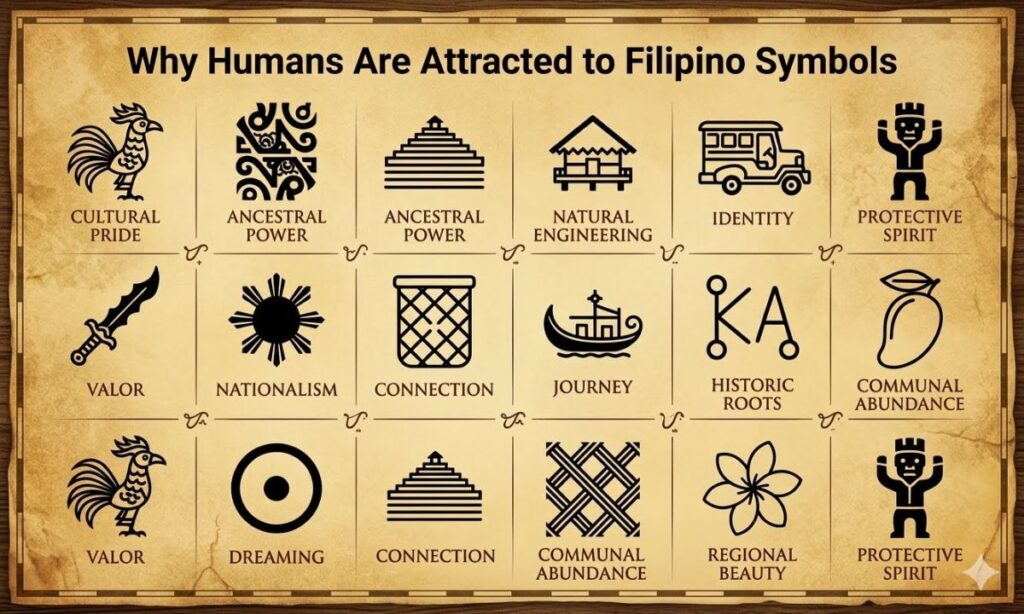
Symbols speak before language, and they outlast it. Filipino symbols attract people — Filipino and non-Filipino alike — because they carry authentic human stories: survival against overwhelming odds, loyalty to family and community, the courage to fight for something worth preserving, and the creativity to make beauty even in hardship.
Psychologically, humans gravitate toward symbols that promise meaning. Emotionally, Filipino symbols offer both pride and comfort. Culturally, they affirm that the Philippines — despite colonization, displacement, and erasure — is still here, still creating, still remembering.
FAQs About Filipino Symbols
What are the most important Filipino symbols?
The Philippine flag, Baybayin script, Philippine Eagle, Sarimanok, anito figures, and okir patterns are among the most historically and culturally significant Filipino symbols.
Are Filipino symbols religious?
Many are spiritual in origin, rooted in animism or indigenous belief, while others blend Catholic and indigenous traditions following centuries of colonial religious influence.
Why is Baybayin popular today?
Baybayin represents cultural revival and resistance against historical erasure — it is a visual declaration that Filipino identity exists before and beyond colonization.
Do Filipino symbols have meanings in dreams?
Yes — sun symbols often suggest awakening or clarity, ancestral figures suggest guidance, and water motifs connect to emotional depth and adaptability rooted in island identity.
Can non-Filipinos use Filipino symbols?
Respectful use paired with genuine understanding and appreciation is generally welcomed; appropriation without awareness or credit is not.
Are Filipino symbols still used today?
Absolutely — they appear in tattoos, national celebrations, fashion, architecture, government design, digital art, and everyday cultural expression across the Philippines and its global diaspora.
Conclusion
Filipino symbols are not relics. They are living voices — of warriors who earned their marks, weavers who encoded ancestry into cloth, revolutionary fighters who wrote freedom in an ancient script, and ordinary people who carried luck charms in their pockets and hung lanterns in their windows.
To understand Filipino symbols is to hear a story that was almost silenced but never was. It is to recognize a culture that turned survival into art, colonization into resilience, and memory into identity. These symbols are not just Filipino history — they are proof of what human beings can preserve when they refuse to forget who they are.

Steve Carell writes simple Symbol Meanings articles on primemegzine.com, helping readers easily understand signs, symbols, and hidden meanings.