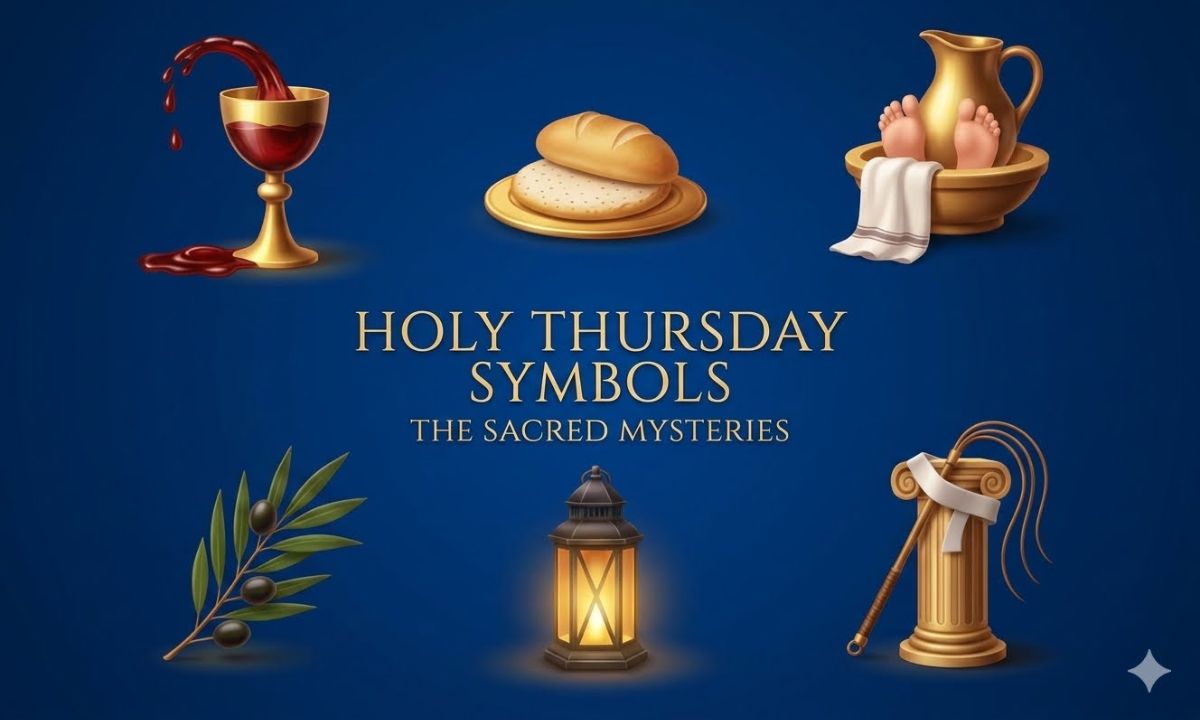
Holy Thursday is a special day in Christianity that remembers the Last Supper of Jesus with His disciples. It is a time of love, faith, sacrifice, and prayer. Many holy symbols connected to this day help people understand the deep meaning behind Jesus’ final meal before His crucifixion.
From bread and wine to candles and washing feet, each Holy Thursday symbol carries a powerful message. These symbols represent humility, forgiveness, unity, and devotion. In this article, you will explore 95+ meaningful Holy Thursday symbols that reveal the true spiritual meaning of the Last Supper.
What Are Holy Thursday Symbols?
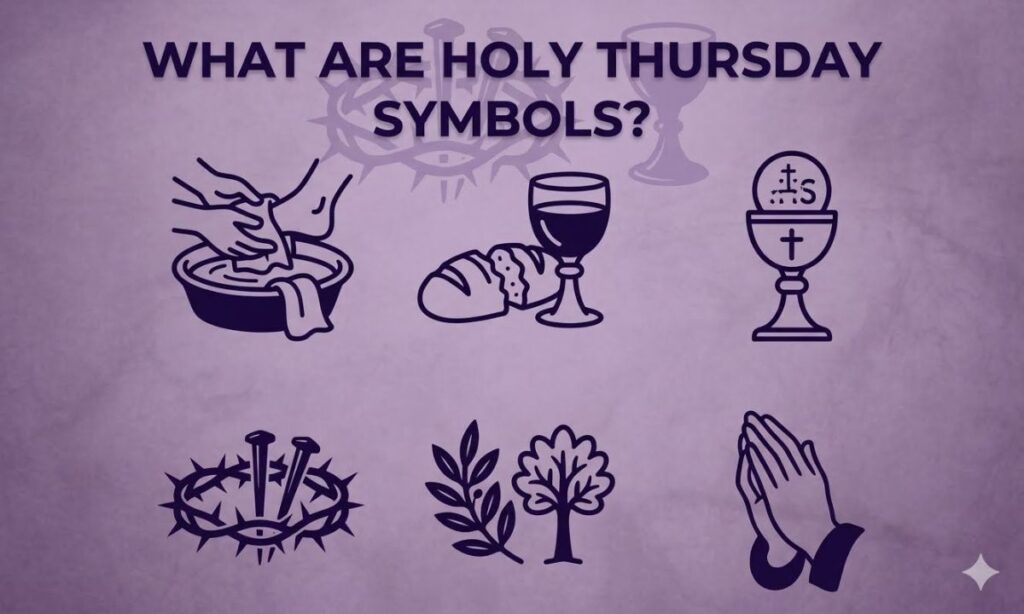
Holy Thursday symbols are sacred signs and ritual objects connected to the observance of Maundy Thursday, the Thursday before Easter Sunday. This day commemorates two pivotal events: the Last Supper of Jesus Christ with His twelve disciples, and His act of washing their feet as a sign of humble service.
These symbols are not decorative. Each one carries theological weight and emotional depth. They point to core Christian beliefs about sacrifice, covenant, and love. Over centuries, they have become woven into church liturgies, religious art, community rituals, and personal devotion practices across the world.
Holy Thursday Meaning And Symbolism
Holy Thursday Meaning
Holy Thursday marks the night Jesus shared His final Passover meal with His disciples, instituted the Eucharist, and gave a new commandment: to love one another as He had loved them. The word “Maundy” comes from the Latin mandatum, meaning commandment, which is exactly what that night centered on. It also marks the beginning of the Paschal Triduum, the three holiest days in Christianity: Holy Thursday, Good Friday, and Easter Sunday.
Thursday Symbolism
In the context of Holy Week, Thursday symbolizes the threshold between ordinary time and ultimate sacrifice. It is the night of intimacy before suffering, of shared meals before betrayal, of humble service before the cross. Thursday sits as a bridge between the living ministry of Jesus and His Passion, making every symbol from that night carry both warmth and sorrow.
Happy Holy Thursday
“Happy Holy Thursday” is a greeting exchanged among Christians to acknowledge the spiritual significance of the day and to spread peace and reflection. While the day is solemn in tone, it carries a deep joy rooted in the gift of the Eucharist and the commandment of love.
Holy Week Symbols And Meanings
Holy Week Symbols And Meanings
Holy Week is rich with visual language. Key symbols across the entire week include:
| Symbol | Day | Meaning |
| Palm branches | Palm Sunday | Triumph and royal welcome |
| Bread and wine | Holy Thursday | Body and Blood of Christ |
| Basin and towel | Holy Thursday | Humility and servant leadership |
| The cross | Good Friday | Sacrifice and redemption |
| Empty tomb | Easter Sunday | Resurrection and new life |
| Chrism oil | Holy Thursday | Consecration and healing |
Good Friday Symbol
The cross is the defining symbol of Good Friday, representing the crucifixion and ultimate sacrifice of Jesus Christ for the forgiveness of sins. It is the most universally recognized symbol in all of Christianity.
Holy Thursday Symbols Catholic
Holy Thursday Symbols Catholic
In Catholic tradition, Holy Thursday is observed with an evening Mass of the Lord’s Supper that includes several highly symbolic rituals. The liturgical color is white, representing purity and the glory of Christ. Key Catholic symbols include the Eucharist, the chalice, holy chrism oil, the washing of feet, the procession to the Altar of Repose, and the stripping of the altar at the close of Mass.
Catholic Holy Thursday Symbols
Catholic Holy Thursday symbols also emphasize the institution of the priesthood. This is the night Catholics believe Jesus ordained His apostles as priests by sharing His body and blood with them. The Chrism Mass, held in the morning by the bishop, blesses three types of holy oil used throughout the year in sacraments, adding another layer of sacred meaning to the day.
Maundy Thursday Symbols Explained
Maundy Thursday Symbols
The core Maundy Thursday symbols include:
- Bread and wine — the Eucharist, body and blood of Christ
- Basin and towel — foot washing, humility and service
- The chalice — covenant and spiritual nourishment
- The stripped altar — abandonment and transition to suffering
- Candles — the presence of Christ in darkness
- Holy chrism oil — anointing, healing, and consecration
- The twelve disciples — community, loyalty, and human fallibility
Symbols Of Maundy Thursday
Symbols of Maundy Thursday reflect three movements: gathering, serving, and departing. The meal symbolizes unity. The foot washing symbolizes love in action. The stripping of the altar symbolizes loss, pointing toward the grief of Good Friday.
Maundy Thursday Symbol
The single most recognized Maundy Thursday symbol is the bread and cup together, representing the institution of the Eucharist and the new covenant Jesus established with humanity at the Last Supper.
Maundy Thursday Holy Thursday Symbols
Both names point to the same sacred event, and the symbols overlap fully. Whether called Maundy Thursday or Holy Thursday, the symbols of bread, wine, basin, towel, and chalice form the visual vocabulary of this day across all Christian denominations.
Symbols Of Holy Thursday
Symbols Of Holy Thursday
The symbols of Holy Thursday work as a unified narrative. Together, they tell the story of a teacher who served His followers, shared His final meal, and prepared them for a future shaped by love and remembrance.
Symbols For Holy Thursday
Symbols for Holy Thursday are used widely in church decorations, liturgical materials, educational content, and devotional art. Common visual representations include the chalice and host, interlocking rings of bread, water flowing from a basin, and feet being washed.
Holy Thursday Symbol
A Holy Thursday symbol is any image or ritual object that points to the events of that sacred night. Each symbol carries both historical memory and living spiritual meaning.
Symbol For Holy Thursday
The symbol most frequently used to represent Holy Thursday in a single image is the chalice with a host, representing the Eucharist as the central act of the night.
Symbol Of Holy Thursday
The symbol of Holy Thursday ultimately points to love made visible, whether in broken bread, poured wine, or kneeling to wash another person’s feet.
Last Supper And Eucharist Symbols
Last Supper Holy Thursday Symbols
The Last Supper is the anchor event of Holy Thursday. Its symbols include the table itself (community and belonging), the bread (body of Christ), the wine (blood of the covenant), the reclining posture of the disciples (trust and closeness), and the presence of Judas (the pain of betrayal within love).
Supper Holy Thursday Symbols
The supper symbols communicate something no sermon alone can. Sharing food is universally understood as an act of intimacy and trust. When Jesus broke bread and passed the cup, He created a ritual of remembrance designed to be repeated across generations.
Holy Eucharist Holy Thursday Symbols
The Holy Eucharist is the central and most theologically significant symbol of Holy Thursday. The bread and wine, transformed into the body and blood of Christ in Catholic and many other Christian traditions, represent ongoing divine presence and sacrificial love. The Eucharist connects every celebration of Holy Communion across time back to that original Last Supper.
Washing Of Feet Symbols
Feet Holy Thursday Symbols
Feet carry deep symbolic meaning throughout scripture. They represent a person’s journey, their lowliness before God, and their belonging to a community. On Holy Thursday, feet become the focus of one of history’s most powerful acts of servant leadership.
Washing Holy Thursday Symbols
The washing ritual points to purification, a cleansing not just of the body but of the soul. Water in Christian symbolism always connects to baptism, renewal, and being made clean before God.
Washing Feet Holy Thursday Symbols
The washing of feet on Holy Thursday is not merely ceremonial. It is a direct enactment of Jesus’ teaching that the greatest among you should serve the rest. It overturns social hierarchy and places love as the foundation of leadership.
Jesus Washing Feet Holy Thursday Symbols
When Jesus knelt before His disciples and washed their feet, it was a radical act. The Teacher became the servant. The Lord took the role reserved for the lowest household worker. This symbol teaches that authentic faith must be expressed through humility and action, not just belief.
Creative And Visual Symbols
Clipart Holy Thursday Symbols
Clipart Holy Thursday symbols are widely used in church bulletins, school religious education materials, websites, and social media content. Common clipart images include a chalice with a host, a basin with water, hands being washed, a towel, loaves of bread, and grape vines.
Action Holy Thursday Symbols
Action symbols refer to the living rituals performed on this night rather than static images. The act of foot washing, the breaking of bread, the procession of the Blessed Sacrament, and the stripping of the altar are all action symbols, sacred gestures that carry meaning through their performance.
Holy Thursday Images And Downloads
Holy Thursday Images Free Download
Many Catholic and Christian websites offer Holy Thursday images available for free download for personal, educational, and parish use. Sites like Catholic Online, Vatican News, and various church resource libraries offer liturgical artwork, photographs from ceremonies, and illustrated symbols that can be used in print and digital formats.
Maundy Thursday Images 2026
Maundy Thursday 2026 falls on April 2. Images from this year’s observances include photographs of Pope Francis and bishops worldwide participating in foot washing ceremonies, liturgical celebrations, and Eucharistic processions. These images circulate widely on social media and news platforms during Holy Week, bringing the symbols of this night to global audiences.
Deep Symbolic Meaning
Holy Thursday symbols operate on multiple levels simultaneously.
On a spiritual level, they communicate divine love made tangible. The bread broken and shared, the wine poured out, the knees bent to wash a disciple’s feet, these are not abstract ideas. They are embodied theology.
On a psychological level, these symbols speak to universal human needs: the need to belong, to be cleansed of guilt, to be served even in vulnerability, and to serve others as an expression of our deepest values.
On a cultural level, Holy Thursday symbols have shaped Western art, moral philosophy, and social ethics for two millennia. The image of a leader washing the feet of his followers has inspired everything from Martin Luther King Jr.’s servant leadership philosophy to modern volunteer movements.
Types / Variations of Holy Thursday Symbols
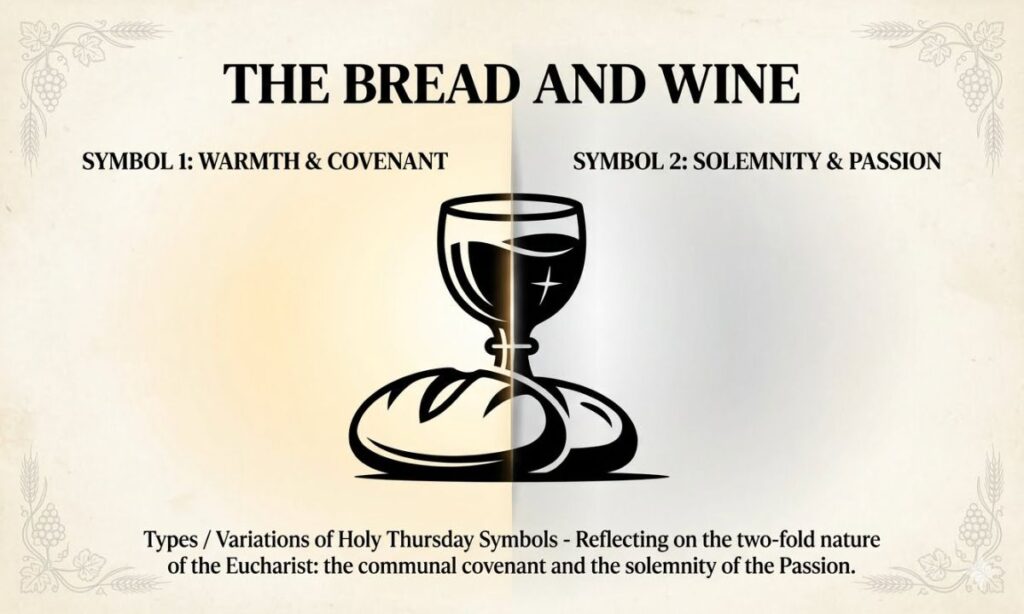
The Bread and Wine
Visual Description: A round loaf of unleavened bread placed beside a cup or chalice of red wine. Meaning: Represents the body and blood of Christ and the new covenant established at the Last Supper. Symbolizes sacrifice, unity, and ongoing remembrance. Where It Appears: Communion ceremonies, religious paintings, church altars, liturgical art, and devotional materials across all Christian traditions.
The Basin and Towel
Visual Description: A simple clay or ceramic bowl filled with water, accompanied by a folded white linen cloth. Meaning: Symbolizes humility, servant leadership, purification, and the call to love one another through action. Where It Appears: Foot washing rituals in churches, religious education materials, and artistic representations of the Last Supper narrative.
The Chalice
Visual Description: An ornate golden or silver cup, often engraved and elevated on a stem. Meaning: Represents the blood of Christ, the new covenant, and spiritual nourishment. In Catholic tradition, the chalice used at Mass traces its symbolism directly back to Holy Thursday. Where It Appears: Altars, tabernacles, religious artwork, ordination ceremonies, and Eucharistic symbols worldwide.
The Twelve Disciples
Visual Description: A group of twelve men gathered around a long table, often depicted in the iconic composition made famous by Leonardo da Vinci. Meaning: Symbolizes community, human imperfection, loyalty, doubt, and the diverse nature of those called to follow Christ. Where It Appears: Paintings, stained glass windows, literature, film, and theological teaching about the Church as a community.
The Stripped Altar
Visual Description: A bare church altar, emptied of all cloths, candles, flowers, and ornaments after the Holy Thursday Mass. Meaning: Represents the abandonment of Christ, the transition from the warmth of the Last Supper to the desolation of the Passion. It prepares the faithful emotionally and spiritually for Good Friday. Where It Appears: Catholic, Anglican, and Lutheran churches at the conclusion of Holy Thursday evening services.
Holy Thursday Symbols Across Cultures
Different cultures bring unique expressions to these universal symbols.
In early Christian communities, bread and wine were shared quietly and secretly during times of Roman persecution, making these symbols signs of both faith and courage.
In medieval Europe, kings and rulers publicly washed the feet of the poor on Maundy Thursday, a tradition that continued in England, where the British monarch distributes Maundy Money to elderly citizens to this day.
In Latin America, Holy Thursday is observed with dramatic processions, community meals, and reenactments of the Last Supper, blending indigenous cultural expression with deep Catholic faith.
In Eastern Orthodox traditions, the foot washing ceremony is highly liturgical and mystical in character, emphasizing divine transformation and the sacred nature of all physical matter.
In African Christian communities, Holy Thursday symbols are often expressed through music, communal gathering, and acts of direct service to the poor, connecting the foot washing symbol to everyday social justice.
Holy Thursday Symbols in Art, Movies and Pop Culture
Leonardo da Vinci’s The Last Supper (1498) remains the most famous artistic treatment of Holy Thursday, capturing the exact moment Jesus announced that one of His disciples would betray Him. The painting is layered with symbolic details, from the arrangement of the disciples to the food on the table.
In film, Holy Thursday themes appear in works like The Passion of the Christ, where the Last Supper is portrayed with emotional intensity, and in countless other narratives exploring sacrifice, betrayal, and redemption.
In literature, writers from Dostoevsky to Graham Greene have drawn on foot washing imagery to explore themes of humility, grace, and the unexpected nature of holy encounters.
In tattoo culture, chalice designs and bread and vine imagery are popular choices for people wanting to carry a personal symbol of faith, remembrance, or sacrificial love.
Spiritual and Dream Meaning of Holy Thursday Symbols
Seeing Holy Thursday symbols in dreams or meditation often signals a period of inner examination and spiritual renewal.
Dreaming of bread and wine may point to a hunger for connection, community, or spiritual meaning in your life. It can also represent a desire for forgiveness or reconciliation.
Dreaming of water and foot washing often suggests emotional cleansing, the releasing of guilt or resentment, or a need to accept care from others rather than always being the one who serves.
A stripped altar in dreams may reflect feelings of emptiness, transition, or loss. Spiritually, it can signal a necessary stripping away of the nonessential before something new can grow.
These symbols, when encountered in the interior life, invite a person toward deeper self-honesty, greater compassion, and a renewed sense of purpose.
Positive vs Negative Meaning
Like all powerful symbols, Holy Thursday symbols carry both light and shadow.
Positive meanings include: love, unity, service, humility, covenant, remembrance, and spiritual nourishment. These symbols at their best inspire people to live generously, lead with service, and stay connected to what truly matters.
Negative or shadow meanings include: betrayal, abandonment, loss, and the pain of knowing that love can be rejected. The Last Supper includes Judas. The stripped altar points to coming darkness. These shadow dimensions do not weaken the symbols; they deepen them. They make the symbols honest about the full complexity of human experience and divine love.
Why Humans Are Attracted to This Symbol
People are drawn to Holy Thursday symbols because they mirror real emotional experiences that everyone shares.
We all understand what it means to share a meal with people we love. We know the weight of a final gathering before loss. We have experienced both the desire to serve others and the vulnerability of being served. We have felt betrayal and forgiveness.
Psychologically, these symbols offer a framework for processing grief, guilt, and gratitude all at once. They give form to experiences that resist ordinary language.
Spiritually, they create continuity, connecting the person holding a piece of bread in a church today to every generation that has done the same across two thousand years. That sense of belonging to a story larger than oneself is profoundly comforting and grounding.
FAQs
What is the main symbol of Holy Thursday?
The bread and wine are the primary symbols, representing the body and blood of Christ and the institution of the Eucharist at the Last Supper.
Why is foot washing important on Holy Thursday?
Foot washing symbolizes Christ’s call to humble service and teaches that true leadership means caring for others before yourself.
What does the stripped altar mean?
The stripped altar represents the abandonment of Christ and marks the emotional and liturgical transition from the Last Supper into the suffering of Good Friday.
Are Holy Thursday symbols only religious?
While rooted in Christianity, these symbols carry universal themes of love, sacrifice, humility, and service that resonate across cultures and beliefs.
What do these symbols mean in dreams?
They typically represent emotional healing, the need for spiritual nourishment, letting go of guilt, or a period of personal transformation and renewal.
Conclusion
Holy Thursday symbols are among the most layered and emotionally resonant signs in human religious history. They do not simply point to a past event. They speak to something permanently true about love, sacrifice, service, and community.
Whether you encounter them in a candlelit church, a great painting, a dream, or a quiet moment of reflection, these symbols invite you to pause, look deeper, and reconnect with what it means to live with humility and intention. In a world that moves fast and forgets easily, Holy Thursday symbols ask you to remember, and in remembering, to live differently.

Steve Carell writes simple Symbol Meanings articles on primemegzine.com, helping readers easily understand signs, symbols, and hidden meanings.